

Most walkers assume that if they have a map, a compass, and a mobile phone, they are safe. The reality is different.
In the UK, over 3,000 mountain rescues take place every year. Many of these aren’t dramatic falls from cliffs; they are simple slips, trips, or navigational errors that spiral into hypothermia because the party wasn’t prepared for the “wait.”
In this guide to hiking emergency procedures, we look at three critical protocols that save lives—and explain why your standard First Aid kit might be the least important thing in your bag.
1. The “Silent” Lifeline: The Emergency SMS Service
You are on a remote ridge. The wind is howling. Your friend has broken their leg. You pull out your phone: No Service.
Most people give up here. But seasoned mountaineers know a secret: Text messages can get through when voice calls fail. A voice call needs a strong, continuous signal. A text packet is tiny; it can “hop” through the network on a weak signal for a fraction of a second.
The Catch: You cannot text 999 unless you have registered before the accident. This is one of the most vital mountain survival tips you will ever learn.
- The Action: Text the word
registerto 999 right now. You will get an automated reply. Text backyes. - The Result: You are now on the emergency database. If you wait until the accident to try this, it will not work.
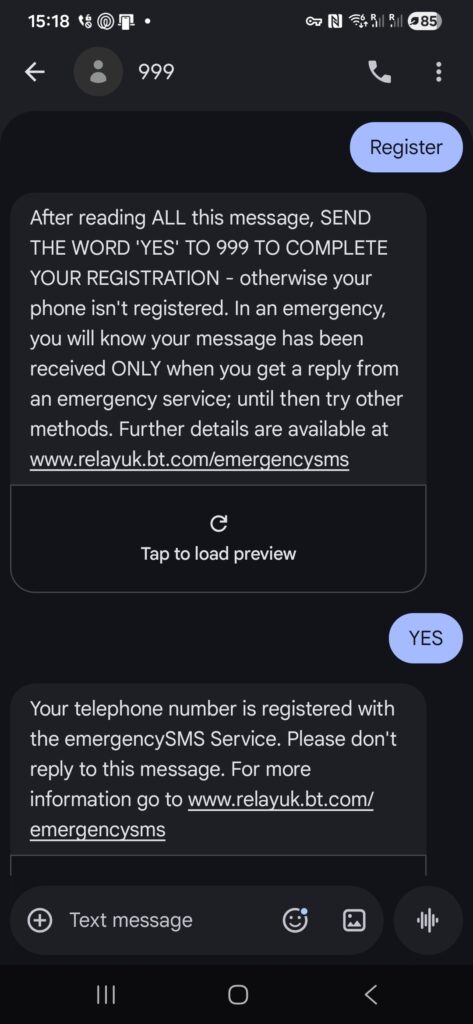
You can find out more in our Text 999 Guide.
Or on the Bt Relay website that runs the service.
2. Hypothermia Protocol: Don’t Just Call—”Package”
The moment you stop walking, your body clock starts ticking. A casualty lying on wet ground loses heat rapidly. Even in summer, a specialised Mountain Rescue team might be 4 hours away. A broken ankle won’t kill your friend, but the hypothermia waiting for the helicopter might.
You need to create a “Micro-Climate.”
- The Trap: Forget the silver foil blanket. It stops wind, but it offers zero insulation. If you wrap a casualty in foil and lay them on the ground, the cold earth will suck the heat straight out of them through the thin plastic.
- The Fix: You need a Group Shelter (Bothy Bag). This lightweight nylon tent fits over your heads and traps body heat, raising the temperature inside by 5–10 degrees in minutes.
- The Rule: Insulate from the bottom up. Put rucksacks and ropes under the casualty before you pile jackets on top of them.
3. What to Do If Lost Hiking: The “S.T.O.P.” Rule
Panic is the biggest killer. When you realise you are lost, the “lizard brain” screams at you to walk faster to find a path. This usually drives you further into dangerous terrain.
- S – Sit: Physically sit down. Eat some sugar (Jelly Babies or something). This breaks the adrenaline loop.
- T – Think: When was the last time you were 100% sure of your location?
- O – Observe: Ignore the path. Look at the wind direction and the slope of the ground.
- P – Plan: Do not move until you have a strategy.
Never Feel Lost Again: The Free UK Navigation & Safety Pack
Stop relying solely on a fragile phone battery. Download the exact tools a professional outdoor instructor uses to stay safe in the British hills.

Enter your email below to get instant access to:
- NEW: The Hike Planning & Safety Checklist: A comprehensive pre-walk checklist to ensure you never leave a critical item behind or rely purely on a smartphone.
- The Emergency Protocol Guide: A highly structured, zero panic system detailing exactly what to do if lost on Dartmoor/Scottish hills, including when and how to call Mountain Rescue.
- The OS Map & Navigation Cheat Sheet: A quick reference guide to decoding complex map symbols and plotting grid references when your mind goes blank.
- The Route Card Template: The exact, logic-driven framework I use to plan foolproof expeditions and identify safe escape routes before leaving the house.
- The Timing Crib Card: Never misjudge daylight again. Master the mathematics of measuring pacing distance and timings for steep ground.
Master the Mountain: The Emergency Procedures Course
The tips above are just the tip of the iceberg. They might save you in the first hour, but what about the next four? What if the helicopter can’t fly? What if you have to walk your injured friend out yourself?
Most “First Aid” courses teach you how to bandage a cut in a warm classroom. They don’t teach you the Fieldcraft of keeping a casualty alive in a freezing storm, or how to get a signal when your phone says “No Service.”
In our full Emergency Procedures Course, we cover the entire timeline of a rescue—from the moment you pack your bag to the moment the winchman lands.
Here is just a few parts of the course master:
- Advanced Preparation: The “Digital Hygiene” protocols to keep your phone alive in sub-zero temps, and the “Silent Rescuer” system that ensures help comes even if you can’t call.
- The “Boot as Cast” Protocol: Why taking a boot off a sprained ankle is dangerous—and the specific “Heel Lock” lacing method that turns your stiff hiking boot into a rigid medical splint so you can walk out.
- The “Fragile Heart” & Hypothermia: Learn the “Burrito Wrap” technique to insulate a casualty using rucksacks and ropes, and why moving them roughly can stop their heart instantly.
- Pro-Level Communication: Forget panic. Learn the METHANE and ATMIST protocols used by Mountain Rescue pros to guarantee they know exactly where you are and what kit to bring.
- Navigation Escape: How to use the “Slope Aspect” trick to pinpoint your exact location on a map using nothing but a compass and the angle of the hill—even in zero visibility.
- Biological & Environmental Hazards: From the truth about Lyme Disease and Adders, to the “Lightning Scatter” drill that stops one strike taking out your whole team.
You don’t need to be a paramedic or a mountain guide to save a life. You just need to know the drill.
Coming in the next couple of weeks Sign up for free to get notified of its release.


