

It’s the question everybody asks before they start, and most answers are either “a weekend course!” or a vague noise about it taking years.
Here’s the honest version. The basics take an afternoon. Being able to reliably say where you are on familiar ground takes about three or four deliberate outings. Being genuinely confident on unfamiliar ground in decent weather takes eight to ten. Trusting yourself in poor visibility takes a season. And the judgement part, knowing when to turn round, never quite finishes.
The reason the usual answers are unhelpful is that navigation isn’t one skill. Below is what it actually breaks into, roughly how long each part takes, and the things that make it faster or slower.
Why “How Long” Is the Wrong Question
Navigation gets talked about as though it’s a single thing you either have or haven’t got. It isn’t. It’s about five separate abilities that develop at very different rates.
Understanding the map is knowledge. You can get most of it in an afternoon.
Relating the map to the ground in front of you is a perceptual skill. It takes repetition, and it’s the one that suddenly clicks.
Using a compass properly is a procedure. Learnable in twenty minutes, reliable after a few dozen goes.
Measuring distance and time is arithmetic plus calibration. An afternoon to learn, a couple of walks to make yours.
Judgement is knowing which of the above to reach for, how much margin to leave, and when to turn round. This is the slow one, and it’s the one that actually keeps you safe.
Lumping those together is why people either think it’s trivial or think it’s impossible. Separated out, it’s a very manageable set of jobs.
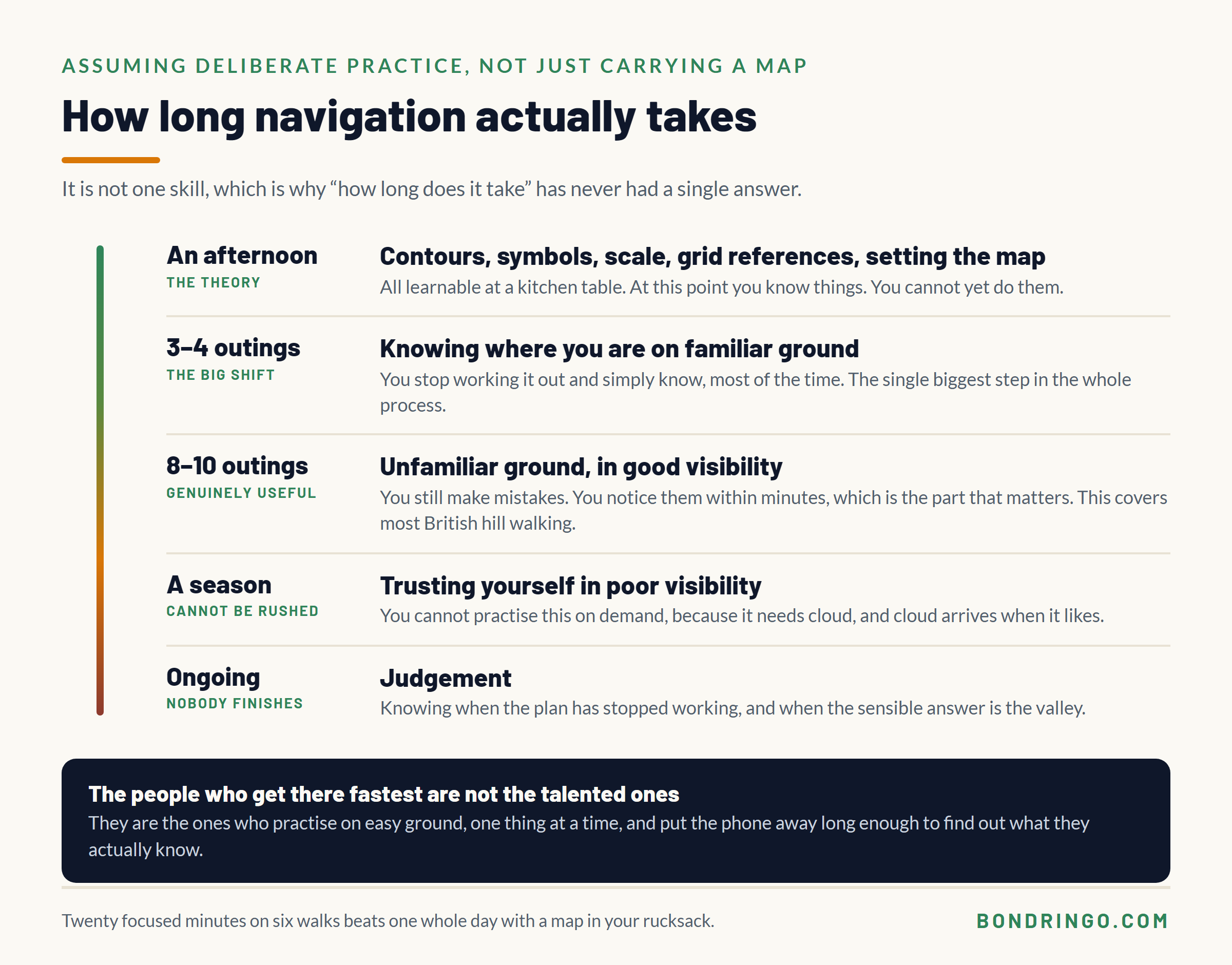
A Realistic Timeline
Assuming you’re doing this deliberately rather than just carrying a map about.
An afternoon: the theory
Contours, symbols, scale, grid references, how to set the map, what a bearing is. All of it is learnable at a kitchen table in a few hours, and none of it is hard.
At this point you know things. You cannot yet do them, and the gap between those two states is the entire rest of this article.
Never Feel Lost Again: The Free UK Navigation & Safety Pack
Stop relying solely on a fragile phone battery. Download the exact tools a professional outdoor instructor uses to stay safe in the British hills.

Enter your email below to get instant access to:
- NEW: The Hike Planning & Safety Checklist: A comprehensive pre-walk checklist to ensure you never leave a critical item behind or rely purely on a smartphone.
- The Emergency Protocol Guide: A highly structured, zero panic system detailing exactly what to do if lost on Dartmoor/Scottish hills, including when and how to call Mountain Rescue.
- The OS Map & Navigation Cheat Sheet: A quick reference guide to decoding complex map symbols and plotting grid references when your mind goes blank.
- The Route Card Template: The exact, logic-driven framework I use to plan foolproof expeditions and identify safe escape routes before leaving the house.
- The Timing Crib Card: Never misjudge daylight again. Master the mathematics of measuring pacing distance and timings for steep ground.
Three or four outings: knowing where you are
This is the first real milestone, and it arrives faster than people expect.
Walk familiar ground with the map out, thumb on your position, checking constantly. Somewhere around the third or fourth time, you stop working out where you are and simply know, most of the time. That shift is the single biggest one in the whole process.
Our guide to practising navigation without getting lost is built entirely around making these outings count.
Eight to ten outings: unfamiliar ground in good weather
Now you can turn up somewhere you’ve never been, in decent visibility, and navigate a route without it being stressful. You’ll still make mistakes. You’ll notice them within a few minutes, which is what matters.
Most people who say they “can navigate” are here, and it’s a genuinely useful place to be. It covers the overwhelming majority of British hill walking.
A season: poor visibility
This is the step that takes real time, because you cannot practise it on demand. You need cloud, and cloud arrives when it likes.
What you’re building is trust in the instruments when your eyes have nothing to offer: taking a bearing and believing it, counting paces and believing them, accepting that the ground you can see does not match your expectation and working out why.
Spread across a walking season with deliberate effort, that’s realistic. Rushed, it isn’t.
Ongoing: judgement
Knowing when the plan has stopped working. Knowing how much margin to leave for a tired group. Recognising the day when the sensible answer is the valley.
Nobody finishes this one, which sounds discouraging and shouldn’t. You get useful at it quite quickly. You just keep getting better indefinitely.
What Makes It Faster
Some things genuinely compress the timeline.
Deliberate practice rather than carrying a map. Twenty minutes of specific practice on six separate walks beats a whole day of having a map in your rucksack. Making a prediction and finding out whether you were right is the mechanism.
Practising where being wrong is free. Familiar ground, close to home. It’s the difference between learning and testing.
One skill per outing. Trying to nail contours, pacing and bearings on the same day means doing all three badly.
Committing to an answer before you check. Glancing at the phone first and then “confirming” it on the map teaches you nothing at all.
Someone competent watching you occasionally. You can practise a subtly wrong technique for months. An instructor spots it in ten minutes, which is the honest argument for spending a day with one at some point. Mountain Training is the awarding body behind the UK leadership qualifications, and its skills courses are a reasonable place to look if you want someone qualified rather than someone confident.
Structure. Working through something in order beats picking things up in a random sequence from articles, because the gaps are what get you.
What Makes It Slower
And some things stop the clock entirely.
The blue dot. If your phone answers the question before you’ve tried to, you never build the skill. This is the biggest single reason capable people stay dependent for years. Our piece on whether your phone is enough covers the honest version of that trade-off.
Only ever walking with someone who navigates. You can do this for a decade and learn almost nothing, because the job is being quietly done for you.
Saving it for big days. People decide they’ll practise navigation when they do something serious, which means practising under pressure on unfamiliar ground, which is the worst possible learning environment.
Waiting to feel ready. The gap between knowing and doing only closes by doing.
The Plateau Everyone Hits
Worth naming, because people mistake it for a lack of talent.
Somewhere after the first handful of outings, progress goes flat. You can read the map, you can find yourself, and yet you don’t feel like a navigator. Nothing seems to be improving.
That’s normal, and it’s almost always the same cause: you’ve got comfortable, so you’ve stopped making predictions and started just following. The plateau breaks the moment you make it slightly harder again. Put the map away for five minutes and relocate. Navigate on a compass bearing to something you can’t see. Go out when it’s a bit grim.
The other thing worth knowing is that the poor-visibility step tends to arrive suddenly rather than gradually. Several outings of feeling like you’re getting nowhere, then a day in cloud where you realise you’re calmly working the problem rather than panicking about it.
How to Tell You’ve Actually Learned It
Not a certificate. These:
- You take the map out more often, not less, and it stops feeling like an admission of doubt.
- You know roughly where you are without stopping to work it out.
- You notice you’ve drifted off route within a couple of minutes.
- You can say what’s over the next rise before you see it, and be right most of the time.
- Cloud coming in makes you thoughtful rather than anxious.
- You turn back sometimes, and it doesn’t feel like failure.
If most of those are true, you can navigate. If you’re still waiting to feel like an expert first, that day doesn’t come, and it isn’t the bar.
If you want to place yourself on the timeline above a bit more honestly, our free Navigation Test is twenty-three questions covering maps, contours, compass work and timing. No signup, about eight minutes, and the explanations at the end tell you which stage you’re actually at.
The Short Version
An afternoon for the theory. Three or four deliberate outings to know where you are on ground you know. Eight to ten to be comfortable somewhere new in good weather. A season to trust yourself in cloud.
The people who get there fastest aren’t the talented ones. They’re the ones who practise on easy ground, one thing at a time, and put the phone away long enough to find out what they actually know.
Frequently Asked Questions
How long does it take to learn map and compass navigation?
The theory takes an afternoon. Reliably knowing where you are on familiar ground takes about three or four deliberate practice outings. Being comfortable navigating unfamiliar ground in good visibility usually takes eight to ten. Confidence in poor visibility takes a walking season, because you can only practise it when the cloud obliges. Judgement carries on developing indefinitely.
Can you learn navigation in a weekend?
You can learn the whole syllabus in a weekend, and many two-day courses cover exactly that. What a weekend cannot do is give you the repetition that turns knowledge into skill. Expect to come away understanding everything and being able to do very little of it under pressure, which is normal. The weekend is the start of the process, not the end of it.
Is navigation hard to learn?
No, and that surprises people. Every individual component is straightforward, and most of them are learnable in an afternoon. What makes it feel hard is that the only obvious way to practise seems to be going somewhere unfamiliar and risking getting lost, which is the thing you were trying to avoid. Practise on ground you already know and the difficulty largely disappears.
How many walks does it take to get confident at navigation?
Roughly three or four deliberate outings to reliably locate yourself on familiar ground, and eight to ten to feel comfortable somewhere new in good conditions. The word doing the work there is deliberate. Carrying a map on twenty walks without using it does not count, whereas twenty focused minutes on each of six walks makes a very visible difference.
Do I need a course, or can I teach myself navigation?
You can absolutely teach yourself the knowledge and most of the skill, and plenty of people do. The thing self-teaching struggles with is that you cannot see your own bad habits, so you can practise a subtly wrong technique for a long time without knowing. A structured course fixes the sequence and the gaps; a day with an instructor at some point fixes the habits.
Why do I feel like I am not improving at navigation?
Almost always because you have got comfortable and stopped making predictions. Once the ground feels familiar it is very easy to slip into following rather than navigating, and following teaches you nothing. Make it slightly harder: put the map away for five minutes and relocate, or walk a bearing to something you cannot see. Progress usually restarts immediately.
Start the Clock Properly
The timeline above assumes deliberate practice with a sensible order to it. That order is most of the advantage.
The free Digital Safety Net course is sixteen lessons and costs nothing, and it covers the foundation everything else sits on: getting your phone and your planning genuinely reliable so you can put the blue dot away without feeling exposed. It’s the fastest way to get off the starting line.
So, where are you on that timeline right now, and which bit is the sticking point? Ask any questions in the comments below.


