

Why do people need mountain rescue? Mostly for very ordinary reasons. In England and Wales in 2025 the commonest recorded reason for a rescue was a slip or trip, the two factors teams logged most often were poor decision making and inexperience, and only 9% of rescues involved a helicopter.
That is the short version, and it comes from the rescue services’ own annual reports rather than from a newspaper.
If you have read the headlines about people being helped off the hills, there is a fair chance you have quietly wondered whether you are the sort of person they are describing. So we are going to go through what the reports actually say, service by service, and then look at what those numbers mean for the way you plan a walk.
Some of it is reassuring. Some of it is a fair challenge.
What are the most common reasons for mountain rescue callouts?
Mountain Rescue England and Wales recorded 3,968 call-outs in 2025, which led to 3,175 team deployments.
When teams logged a primary reason for the rescue, two came out on top. A slip or trip accounted for 22%, and a search for a missing person accounted for 18%.
Underneath that sits a second list, and it is the more interesting one. MREW also records contributory factors, the things that were going on in the background of an incident. These are their categories and their counts, not our reading of them.
- Poor decision making or human error: 939
- Inexperience of pursuit: 644
- Weather, covering freak conditions, rain, wind, snow, ice and heat: 518
- Equipment failure or poorly equipped: 241
- Tired, fatigued or unfit: 199
- Poor visibility: 138
Three things are worth saying about that list before we go any further.
First, a single incident can carry several factors at once. The counts are mentions, not incidents, so they do not add up to a total and were never meant to.
Second, look at the order. Poor decision making and inexperience were each recorded more often than weather, and far more often than kit or fitness. What teams wrote down most was about the judgement of the person, not the ground underneath them.
Third, and this matters for anything you read about what causes mountain rescue callouts, these are factors the teams recorded as present. They are not causes anybody has proved. The reports are careful to say what was going on, not to explain why, and we are going to be careful about that too.
That is a more hopeful finding than it first sounds, because judgement is a learnable thing. Nobody is born knowing when to turn around.
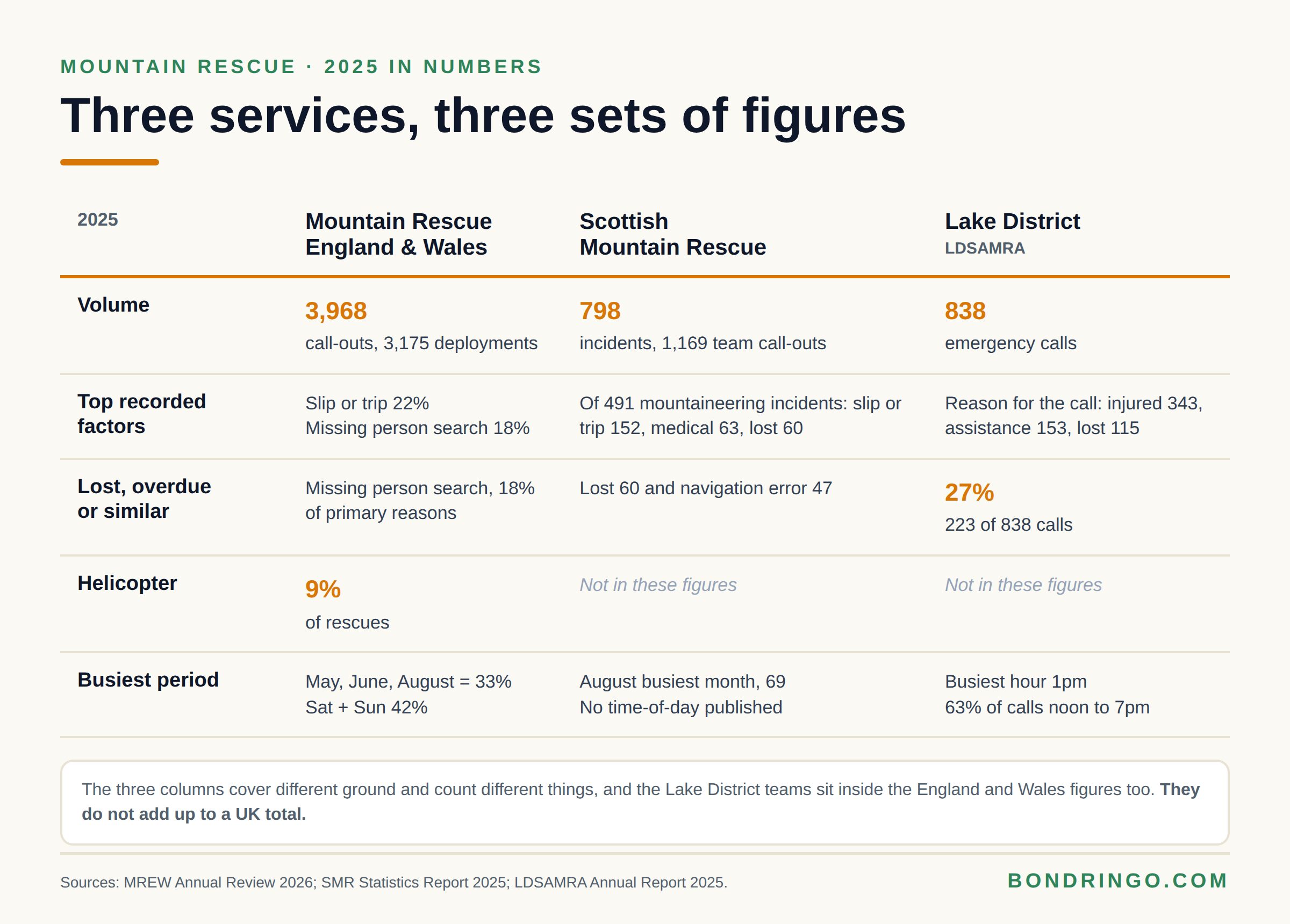
What do the 2025 figures actually say, service by service?
One thing to get straight before you read the table. There is no single UK mountain rescue statistic, because there is no single UK mountain rescue organisation.
Mountain Rescue England and Wales, Scottish Mountain Rescue and the Lake District Search and Mountain Rescue Association each count different things across different ground, and the Lake District teams appear in the England and Wales figures as well as reporting their own. The columns below are not addable. Anyone who hands you one clean UK number has built it themselves.
| Mountain Rescue England & Wales | Scottish Mountain Rescue | Lake District (LDSAMRA) | |
|---|---|---|---|
| 2025 volume | 3,968 call-outs, 3,175 deployments | 798 incidents, 1,169 team call-outs | 838 emergency calls |
| Top recorded factors | Slip or trip 22%, search for a missing person 18% | Of 491 mountaineering incidents: slip or trip 152, medical 63, lost 60 | Reason for the call: injured 343, assistance requested 153, lost 115 |
| Lost, overdue or similar | Search for a missing person, 18% of primary reasons | Lost 60 and navigation error 47, across 491 mountaineering incidents | 223 of 838 calls, 27% |
| Helicopter | 9% of rescues | Not in the figures used here | Not in the figures used here |
| Busiest period | May, June and August together 33% of incidents; Saturday and Sunday 42% | August the busiest month at 69 incidents; SMR does not publish time of day | Busiest hour 1pm; 63% of calls between noon and 7pm |
Sources for the table, in order: the MREW Annual Review 2026, the Scottish Mountain Rescue Statistics Report 2025 and the LDSAMRA Annual Report 2025.
There is one more thing the numbers do not show you, and it matters. The great majority of teams are volunteer charities, but not all of them. Scottish Mountain Rescue’s membership includes police teams and an RAF team, and the RAF Mountain Rescue Service runs its own government-funded teams.
So most, though not quite all, of the people who would come out for you are unpaid volunteers who dropped whatever they were doing to come.
How many callouts are people who simply could not find their way?
This is the question the headlines never ask, and it is the one that should interest you most.
The Lake District teams publish the reason for every 999 call they take. In 2025 that was injured 343, assistance requested 153, lost 115, medical 70, overdue 67, split from party 17, missing 14 and benighted 10.
Add the five that are variations on the same theme, being lost, overdue, missing, benighted or separated from your group, and you get 223 of 838 calls, a little over a quarter. That is before you count any of the 153 logged simply as assistance requested.
Scotland tells a similar story in a different format. Across the 491 mountaineering incidents in 2025, Scottish Mountain Rescue recorded lost 60 times and navigation error 47 times. That is 107 mentions, so up to about one incident in five carried a navigation factor. Up to, because one incident can be logged with both.
Here is what makes that group different from a broken ankle.
A slip on wet rock is bad luck. Losing track of where you are is a skills gap, and skills close. Nobody needs to be a better person to fix it. They need a habit, which is knowing roughly where you are on the map at all times, so that being unsure never turns into being lost.
If you have ever had that cold moment of not recognising anything around you, our guide on what to do if you get lost hiking walks through the procedure calmly. It is also worth reading the five navigation mistakes that get people lost, because they are the ordinary ones, not the exotic ones.
Never Feel Lost Again: The Free UK Navigation & Safety Pack
Stop relying solely on a fragile phone battery. Download the exact tools a professional outdoor instructor uses to stay safe in the British hills.

Enter your email below to get instant access to:
- NEW: The Hike Planning & Safety Checklist: A comprehensive pre-walk checklist to ensure you never leave a critical item behind or rely purely on a smartphone.
- The Emergency Protocol Guide: A highly structured, zero panic system detailing exactly what to do if lost on Dartmoor/Scottish hills, including when and how to call Mountain Rescue.
- The OS Map & Navigation Cheat Sheet: A quick reference guide to decoding complex map symbols and plotting grid references when your mind goes blank.
- The Route Card Template: The exact, logic-driven framework I use to plan foolproof expeditions and identify safe escape routes before leaving the house.
- The Timing Crib Card: Never misjudge daylight again. Master the mathematics of measuring pacing distance and timings for steep ground.
What does a mountain rescue actually look like?
Not much like the television version.
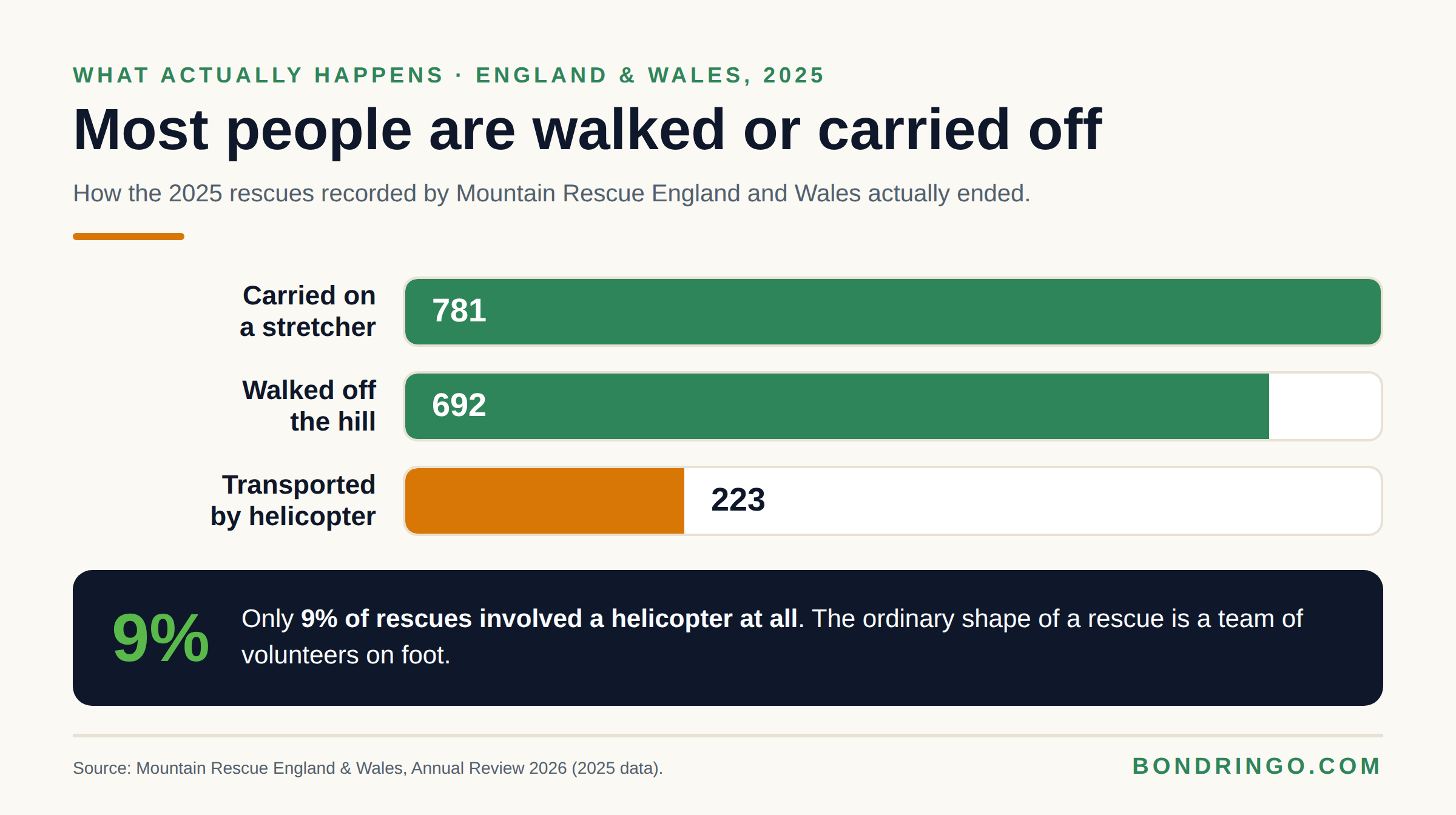
Of the interventions MREW recorded in 2025, 692 people were walked off the hill and 781 were carried on a stretcher. Teams used a vehicle 446 times and applied limb splintage 423 times. Helicopters transported 223 casualties, and MREW records that only 9% of rescues involved a helicopter at all.
So the ordinary shape of a rescue is a group of volunteers walking in to you, sorting out whatever is wrong, and walking or carrying you back out.
The injury list is ordinary too. Ankle and foot injuries came top at 354, then lower leg at 111, head at 99 and knee at 95.
None of that is meant to make it sound trivial. A stretcher carry off a fell is long, heavy work for the team doing it. But if the picture in your head is a winch and a rotor, the figures say otherwise, and that is worth knowing before you talk yourself out of ringing for help.
If you want the process rather than the numbers, we have covered what actually happens when you call mountain rescue separately, from the 999 call to the team reaching you.
So who is actually getting rescued?
You will have seen the answer in a headline. Young people, phones, social media. The data is more interesting than that.
It is true that the age profile has shifted. In Ordnance Survey’s analysis of the MREW figures, 18 to 24 year olds went from 166 assisted in 2019 to 314 in 2024, and Scottish Mountain Rescue recorded 17 to 25 year olds as its most rescued age group in 2025, at 106 of the 425 people whose age was recorded.
But look further down the same table. The 75 to 79 group also doubled, from 56 to 112, and the 70 to 74 group rose from 109 to 135.
That is not a story about youth. It is a story about people who are new to the hills, which a Lake District rescue spokesperson put plainly to the Whitehaven News in March 2026: “I think we’ve got a whole generation of people who are new to the mountains with no background.”
On social media specifically, be careful what you believe, including from us. None of the three services records social media as a cause of anything. MREW says as much in its own review, noting that media interest focused on the negative influence of social media and route apps while leaving the teams with the question of how to reach that group.
What does exist is rescuers saying what they see. Mike Park, chief executive of MREW, told the Guardian in April 2025 that people are “tempted into risky locations by Instagram posts” and that there is “a tendency to follow popular routes online without knowing the hazards and context”. Llanberis Mountain Rescue Team, in a statement to BBC Wales in September 2026, put it more evenly: “The mountains have not suddenly become more dangerous. More people are visiting them, and the way routes are discovered and accessed has changed.”
That is a fair description, and there is no percentage attached to it, because nobody collects one.
And whoever you are, this is the line worth keeping. Ogwen Valley Mountain Rescue Organisation, writing in MREW’s own annual review, said it better than we could: “everyone needs a hand at some point, regardless of ability or experience.”
What the figures mean for your next walk
Here is the honest read, from someone who teaches the people these figures describe.
The factor lists are not a list of character flaws. They are a list of small, specific, fixable things, and each one has a habit attached to it.
- Poor decision making, 939 mentions. Set a turnaround time before you leave and honour it. The hard part is not knowing you should go back, it is deciding while you still have options.
- Inexperience, 644. Build up gradually. The mistake is not being new, it is picking a route that assumes you are not.
- Weather, 518. Read the mountain forecast, not the town one, and know what you will do if it arrives early.
- Poorly equipped, 241. A torch, spare layers, food and a way of keeping warm if you stop. The torch in particular, because benighted walkers appear in both the Scottish and the Lake District figures.
- Tired or unfit, 199. Plan the day on your real pace, not your best one.
- Poor visibility, 138. This is the one that turns a nice walk into a navigation problem, and it is the one worth practising for on a good day.
The Lake District teams say the same thing more briefly in every annual report. “Many calls to Mountain Rescue Teams are avoidable.” And, on when things tend to unravel: “Many accidents occur towards the latter part of the day when both your energy levels and those of your phone and GPS batteries will be run down.”
Their third standing line is the one to actually take with you. “It is no disgrace to turn back if you are not certain.”
Notice that none of those is a skill you need a mountain for. You can build every one of them at home and on low ground, then take them up the hill with you. If you want the emergency side laid out end to end, our guide to hiking emergency procedures and survival tips covers what to do when the day has already gone wrong.
Frequently Asked Questions
What are the most common reasons for mountain rescue callouts?
In England and Wales in 2025, the commonest primary reason recorded was a slip or trip, at 22% of call-outs, followed by a search for a missing person at 18%. Separately, the contributory factors teams recorded most often were poor decision making or human error, with 939 mentions, and inexperience, with 644. In the Lake District, the commonest reason for a 999 call was someone being injured, with being lost the third commonest.
How many mountain rescue call-outs are there each year?
Mountain Rescue England and Wales recorded 3,968 call-outs in 2025, up from 3,784 in 2024. Scottish Mountain Rescue recorded 798 incidents and 1,169 team call-outs. The Lake District teams took 838 emergency calls. Those figures cover different areas and count different things, so they cannot be added together into a single UK total.
Do most mountain rescues involve a helicopter?
No. Only 9% of rescues recorded by Mountain Rescue England and Wales in 2025 involved a helicopter, with 223 casualties transported that way. In the same year 692 people were walked off the hill and 781 were carried on a stretcher. The normal outcome is a team of volunteers on foot, not an aircraft.
Are mountain rescue call-outs avoidable?
Some clearly are, though no service publishes a figure for how many. The Lake District teams state in every annual report that “many calls to Mountain Rescue Teams are avoidable”, and their 2024 chair’s report named preventable call-outs by parties who had not planned adequately, ending up lost, caught out by weather or separated. Treat any precise percentage you are quoted with suspicion, because no service publishes one.
Is it mostly inexperienced walkers who get rescued?
Inexperience is recorded as a factor often, 644 times by MREW in 2025, but it is not the whole picture. The age data shows rises at both ends, with 18 to 24 year olds up from 166 to 314 between 2019 and 2024 and the 75 to 79 group doubling from 56 to 112 over the same period. As Ogwen Valley Mountain Rescue Organisation put it, “everyone needs a hand at some point, regardless of ability or experience.”
The Figures Are a Syllabus, Not a Telling Off
Read the factor lists again and you will notice something. Almost every line on them is a lesson.
Knowing when to turn back. Reading a forecast properly. Keeping track of where you are so that poor visibility is an inconvenience rather than an emergency. Carrying the few things that turn a long night into an uncomfortable one. Making a clear call for help when you need it.
That is exactly what our Emergency Protocol Course is built from. It is £27, it is yours for good, and it works through the situations these reports describe, one at a time, in the order they tend to happen. At least £3 from every sale goes to mountain rescue services across the UK.
Before your next walk, try one thing from this article. Pick your turnaround time before you set off, write it on the back of your hand if you have to, and see whether you actually honour it.
Ask any questions in the comments below.


