

Most people know you dial 999 and ask for the police. Almost nobody knows what happens next, and that gap is where a lot of the fear sits.
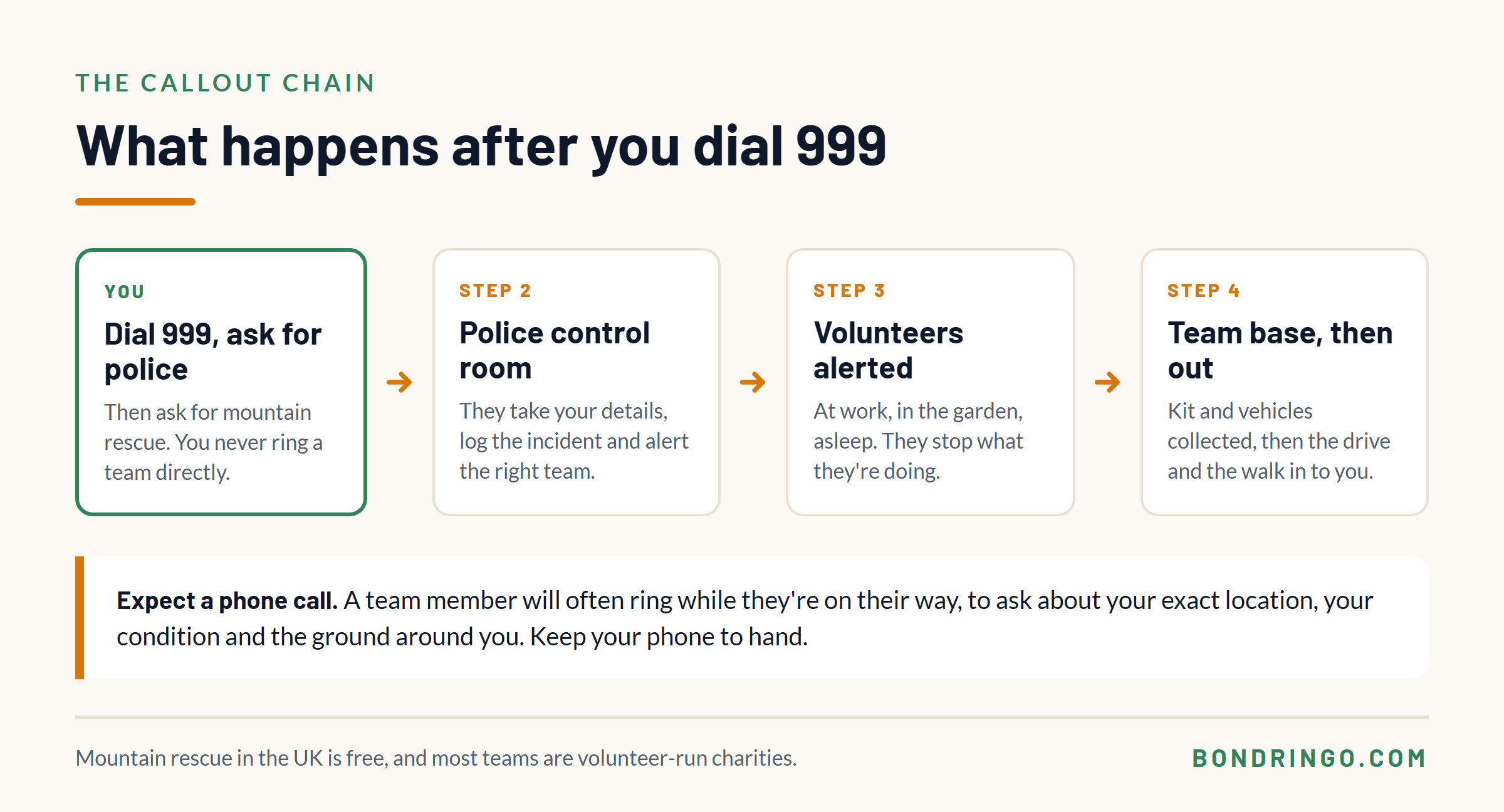
Here’s what happens when you call mountain rescue in the UK. Your call goes to a police control room, who log it and alert the mountain rescue team covering that patch. Within minutes, a group of unpaid volunteers stop whatever they’re doing, head for the team base, collect kit and come out to find you. Somebody will probably ring you back on the way.
That’s the whole shape of it. In this guide we’re going to walk through it properly, from who these people actually are to how long you can expect to wait, because knowing what’s coming makes a bad day considerably less frightening.
Who Mountain Rescue Actually Are
This is the bit that surprises people most.
Across England, Wales and Scotland, the great majority of mountain rescue teams are charities staffed by unpaid volunteers. They aren’t employed to do this. They have jobs, families and Sunday lunches, and they leave all of it when the call comes.
There are exceptions worth knowing about. A small number of teams are run by the police, and the RAF Mountain Rescue Service operates three teams across Scotland, England and Wales. Those are government funded. But the bulk of the work in the British hills is done by volunteers.
The scale of the commitment is genuinely hard to take in. Scottish Mountain Rescue alone has around 850 volunteers, who put in roughly 85,000 hours of training a year on top of the callouts themselves.
And there’s one more thing worth saying plainly, because it stops people picking up the phone.
Mountain rescue in the UK is free. You will not get a bill. Nobody is going to charge you for a bad decision or a twisted ankle.
What Happens in the Minutes After You Hang Up
Right, let’s walk through it.
1. Your call reaches a police control room. In the UK, mountain rescue is called out by the police, which is why you ask for police first rather than trying to ring a team directly. The control room takes your details and logs the incident.
2. The team gets alerted. The relevant team is notified, and their members get the callout wherever they happen to be. At work, in the garden, asleep.
3. People start moving. Team members respond from wherever they are and head for the team base to pick up kit and vehicles. How many turn out depends entirely on the job. A straightforward walk-off might need a handful of people. A search for someone who can’t say where they are can pull in dozens.
4. Somebody may ring you back. Don’t be startled by this. A team member will often phone while they’re on their way to get more detail about your location, your condition, and what the ground around you looks like.
That call is useful, so keep your phone somewhere you’ll hear it and try to keep the battery alive.
How They Find You
The single most useful thing you can give them is a location.
If you can provide a six-figure grid reference, do. If you can’t, describe what you can actually see. The valley you’re in, the summit above you, a wall, a stream junction, a forestry edge. Rescuers know their patch extremely well and a good description often gets them close. If you have a phone but no mapping app, the free grid reference finder gives you a six-figure grid reference from the phone’s GPS at the press of a button, in the browser.
Most teams will also text you a link that uses your phone’s GPS to send your position straight to their mapping. You just tap it. It takes seconds and works on a weak signal.
I’ve covered the mechanics of the call itself, including exactly what to say and how to send your location, in our guide on what to do if you get lost hiking. It’s also well worth registering your phone for the emergency SMS service before you need it, because a text will sometimes get out where a voice call won’t.
Never Feel Lost Again: The Free UK Navigation & Safety Pack
Stop relying solely on a fragile phone battery. Download the exact tools a professional outdoor instructor uses to stay safe in the British hills.

Enter your email below to get instant access to:
- NEW: The Hike Planning & Safety Checklist: A comprehensive pre-walk checklist to ensure you never leave a critical item behind or rely purely on a smartphone.
- The Emergency Protocol Guide: A highly structured, zero panic system detailing exactly what to do if lost on Dartmoor/Scottish hills, including when and how to call Mountain Rescue.
- The OS Map & Navigation Cheat Sheet: A quick reference guide to decoding complex map symbols and plotting grid references when your mind goes blank.
- The Route Card Template: The exact, logic-driven framework I use to plan foolproof expeditions and identify safe escape routes before leaving the house.
- The Timing Crib Card: Never misjudge daylight again. Master the mathematics of measuring pacing distance and timings for steep ground.
How Long Will You Be Waiting?
It varies enormously, and it helps to expect the longer end of that.
Think about what has to happen. People have to receive the callout, travel to base, kit up, drive out to the nearest access point, then walk in to you. On a hill, in the dark, in bad weather, that walk-in is not quick.
How long all that takes depends on where the team is based, how far you are from a road, the weather and the light. If you’re close to an access point and the team turns out quickly it can be fast. It can also be a great deal longer.
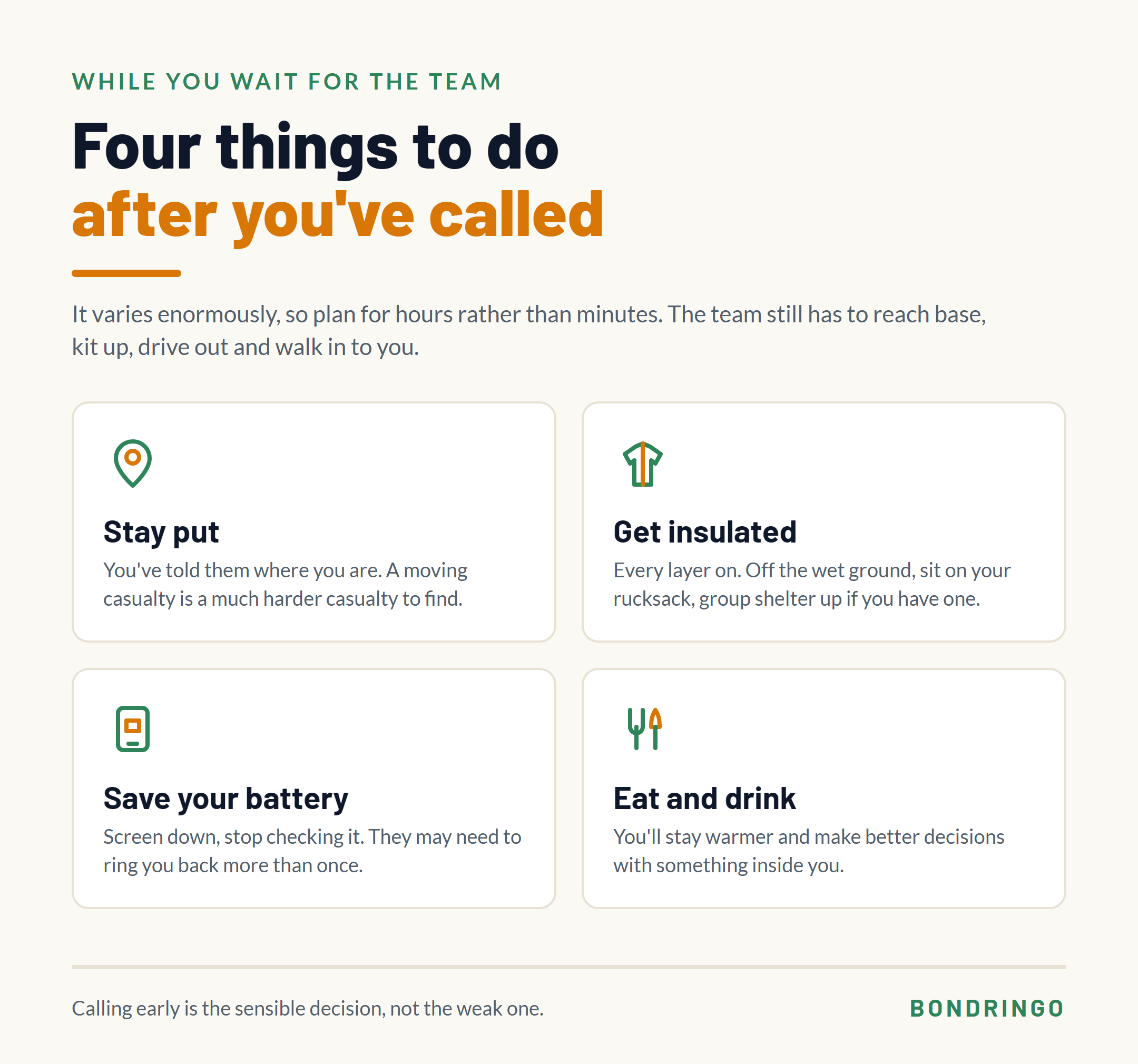
Plan for hours rather than minutes, because assuming the best case is what leaves people cold and unprepared. Then use the time well.
Stop moving. If you’ve told them where you are, staying there is the single most helpful thing you can do. A moving casualty is a much harder casualty to find.
Get warm and get insulated. Put on every layer you have. Get off the wet ground if you can, sit on your rucksack, and get inside a group shelter or bivvy bag if you’re carrying one. Standing still in the wind is how a manageable situation turns into a serious one.
Protect your phone battery. Turn the screen brightness down, stop checking it, and consider airplane mode between agreed contact times if you’re desperately low.
Eat and drink something. You’ll make better decisions and stay warmer with fuel in you.
What Happens When They Reach You
The first thing that usually happens is that someone talks to you, which is worth more than people expect.
After that, the team will assess any injuries and give casualty care on the spot. If you need moving, you’ll be packaged properly, which usually means insulation, protection from the weather, and a stretcher if you can’t walk.
Then you get taken off the hill. Sometimes that’s a walk out with support. Sometimes it’s a carry, which is slow, physical work and often needs a lot of hands.
A helicopter may be tasked, depending on the injury, the terrain, the weather, the light and what else is happening that day. Don’t plan your day around the assumption that one will be available.
None of this is dramatic in the way television suggests. It’s methodical, and that’s exactly what you want.
They Would Much Rather You Called Early
If you take one thing from this article, take this.
It’s the message rescue teams put out more consistently than any other. They would far rather come out to somebody who made a sensible call while things were still manageable than be called at midnight to a situation that has been quietly deteriorating for six hours.
Calling early is not wasting their time. It’s the thing that keeps a bad day from becoming a serious one.
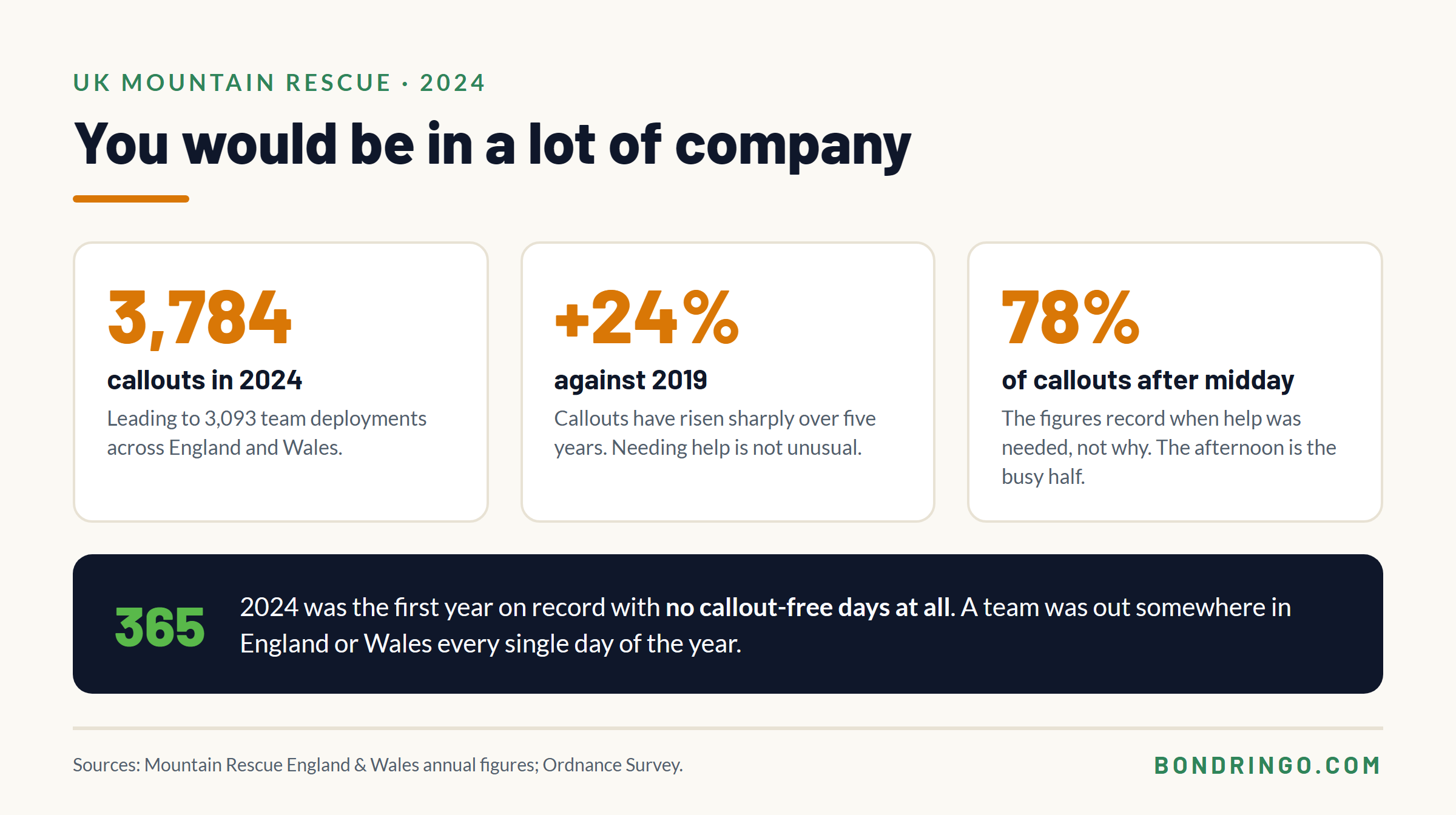
And you would be in a lot of company. Mountain Rescue England and Wales recorded 3,784 callouts in 2024, leading to 3,093 team deployments, which is a 24% increase on 2019. Perhaps the most striking figure in that report is this one: 2024 was the first year on record with no callout-free days at all. A team was out somewhere in England or Wales every single day of the year.
There’s a pattern in when it happens, too. Around 78% of callouts in 2024 came after midday, peaking through the afternoon.
The figures record when help was needed, not why, and it’s worth resisting the urge to invent a reason. What they do tell you is that the second half of the day is when things most often go wrong, which is a decent argument for starting early and building your timings around the afternoon rather than the morning.
What Changed in 2025
Mountain Rescue England and Wales published its 2025 figures in May 2026. We’ve left the 2024 figures above as they were and put the new ones next to them, so you can see both years.
In 2025 its teams recorded 3,968 callouts, leading to 3,175 team deployments. In 2024 it was 3,784 callouts and 3,093 deployments.
| England and Wales | 2024 | 2025 |
|---|---|---|
| Callouts | 3,784 | 3,968 |
| Team deployments | 3,093 | 3,175 |
| Casualties walked off the hill | 534 | 692 |
| Busiest months | July and August (23% of incidents) | May, June and August (33% of incidents) |
Sources: MREW annual figures for 2024, and the MREW Annual Review 2026 for 2025 and the 2024 walked-off figure.
Most people are walked or carried off by volunteers on foot. Only 9% of rescues in England and Wales involved a helicopter in 2025, and that year 692 casualties were walked off the hill and 781 were stretchered.
For time of day, the 2025 figures we have come from the Lake District. The Lake District Search and Mountain Rescue Association had its busiest hour for emergency calls at 1pm, and 63% of its calls came between noon and 7pm. That’s one region and a different time window from the 2024 England and Wales figure above, so the two don’t compare directly.
The Annual Review also lists what teams recorded as contributing to each incident, and one incident can carry several factors. In 2025, “poor decision making / human error” was recorded in 939 incidents and “inexperience of pursuit” in 644, against 518 for weather. Those are the review’s own category names.
If you ever find yourself on the wrong side of one of those, call anyway, and call early.
The Best Outcome Is Never Needing Them
None of this should make you nervous about going out. It should make you a bit more deliberate about how you go out.
Look at what actually causes incidents. In Scotland in 2025, the leading contributing factors to mountaineering incidents were slips and trips, medical issues, and being lost, with navigation-related causes making up a large block just behind injuries.
That last group is the interesting one, because it’s the most preventable. Being lost, making a navigation error and running late are not bad luck. They’re skills gaps, and skills can be closed.
Knowing where you are on the map at all times. Timing a route honestly and setting a turnaround. Being able to relocate when you’ve drifted. Those habits are what keep the phone in your pocket.
If you’d like to build them properly, our guide to using a map and compass on the hill is the place to start.
Frequently Asked Questions
Do you have to pay for mountain rescue in the UK?
No. Mountain rescue in the UK is provided free of charge, and most teams are registered charities run by volunteers. You will not receive a bill, whatever the reason for the callout. This is deliberate, because the moment people start weighing up a possible cost is the moment they delay calling, and delay is what turns manageable situations into serious ones.
How do you call mountain rescue?
Dial 999 and ask for the police, then ask for mountain rescue. You don’t contact a team directly. The police control room logs the incident and alerts the team covering that area. If you have no voice signal, a text to 999 will sometimes get through where a call won’t, but your phone must be registered for the service in advance.
Is it embarrassing to call mountain rescue?
It shouldn’t be, and teams go out of their way to say so. They would much rather attend early, while the situation is still straightforward, than be called hours later when someone is hypothermic in the dark. Nobody on a rescue team is judging you. Calling early is the sensible decision, not the weak one.
How long does mountain rescue take to arrive?
It varies enormously, so plan for hours rather than minutes. Volunteers have to receive the callout, get to their team base, collect kit, drive to the nearest access point and then walk in to you, often over rough ground and sometimes in the dark. How long that takes depends on where the team is based and how far you are from a road. Stay where you are, get as warm and insulated as you can, and protect your phone battery while you wait.
What information should you give when you call?
Your location first, ideally a six-figure grid reference, or a clear description of what you can see if you can’t give one. Then how many people are with you, whether anyone is injured and how badly, the weather where you are, and what you’re wearing. Say how much phone battery you have left, because that shapes how they stay in contact with you.
Will a helicopter come?
Sometimes. A helicopter may be tasked depending on the injury, the terrain, the weather, the light and what else is happening that day. In 2025 only 9% of rescues in England and Wales involved one, and most people were walked or carried off by the team on foot, which is slow, physical work. Don’t plan your day around the assumption that a helicopter will be available.
Give Yourself One Less Thing to Worry About
The best version of this article is one you never need.
Our free Digital Safety Net course covers the preparation that makes a call far less likely, and far more useful if you ever do make one. Registering for emergency SMS, setting up your phone so it survives the day, finding your grid reference, and knowing what to do in the first few minutes when something goes wrong. It’s free and you can work through it at your own pace.
Have a go at this before your next walk. Find out which mountain rescue team covers the area you’re heading to, and check you can find a six-figure grid reference for your planned lunch stop. Two small jobs, ten minutes, and you’ll have closed most of the gap.
Ask any questions in the comments below.


