

You’re coming down off the ridge, the light is going, and you do the maths on the last train for the third time in ten minutes. It isn’t going to work.
Here’s the short version. Missing the last train off the hill is an inconvenience, not an emergency, and the most dangerous thing you can do is treat it like one. Nobody has ever been hurt by a missed train. People get hurt rushing a descent in bad light to catch one. So you slow down, you get off the hill at a sensible pace, and you solve the transport problem from somewhere warm and flat with a phone signal.
Below is how to tell a genuine emergency from an expensive nuisance, what to do in what order once you’ve missed it, and the one planning habit that stops the whole situation happening again.
First, Is This a Problem or an Emergency?
This matters more than anything else in the article, so let’s be really clear about it.
A missed train is a logistics problem. You know where you are, you can walk, you’re not injured, and you have options. It costs money and dignity. It does not cost anything else.
An emergency is different. You’re injured, or someone in your group is. You’re getting properly cold and can’t warm up. You genuinely don’t know where you are and can’t work it out. You’re on ground you can’t safely descend in the dark.
If you’re in that second list, stop reading and dial 999, ask for Police, then Mountain Rescue. If you’ve no voice signal, a registered text to 999 can get through where a call won’t, which is why it’s worth registering your phone to text 999 before you ever need it. Takes about a minute.
One thing a lot of people don’t know: once you’re in contact, a UK Mountain Rescue team can text you a link, and tapping it hands them your phone’s GPS position directly. So keep some battery back. It’s the difference between describing where you think you are and simply showing them.
And if the real problem is that you’re not certain where you are, that’s a different article: what to do if you get lost hiking.
The reason I labour this distinction is that the two situations get confused, and the confusion runs both ways. Some people call Mountain Rescue because they’ve missed a train, which isn’t what a team of unpaid volunteers is for. Far more people do the opposite, and push on through genuinely dangerous ground because they’re embarrassed about the alternative.
Being late is embarrassing for about an hour. Get that in proportion.
The Decision Happens on the Hill, Not on the Platform
Now, the useful part.
By the time you’re standing on an empty platform reading a departure board, every decision that mattered has already been made. The real moment was two or three hours earlier, somewhere up on the hill, and you probably walked straight past it.
That moment is your turn-around time. It’s a time you decide before you set off, and it means this: if I’m not at this point by this time, I turn around or I take the escape route, regardless of how close the summit looks.
This matters more on a station-to-station walk than on a loop, because there is no car sitting at the trailhead as a default bail-out. We’ve written separately about what actually changes between point-to-point and circular walks.
The reason it works is that it moves the decision to a moment when you’re warm, fed and thinking clearly, rather than one when you’re tired and the summit is right there. Tired brains are bad at maths and very good at optimism.
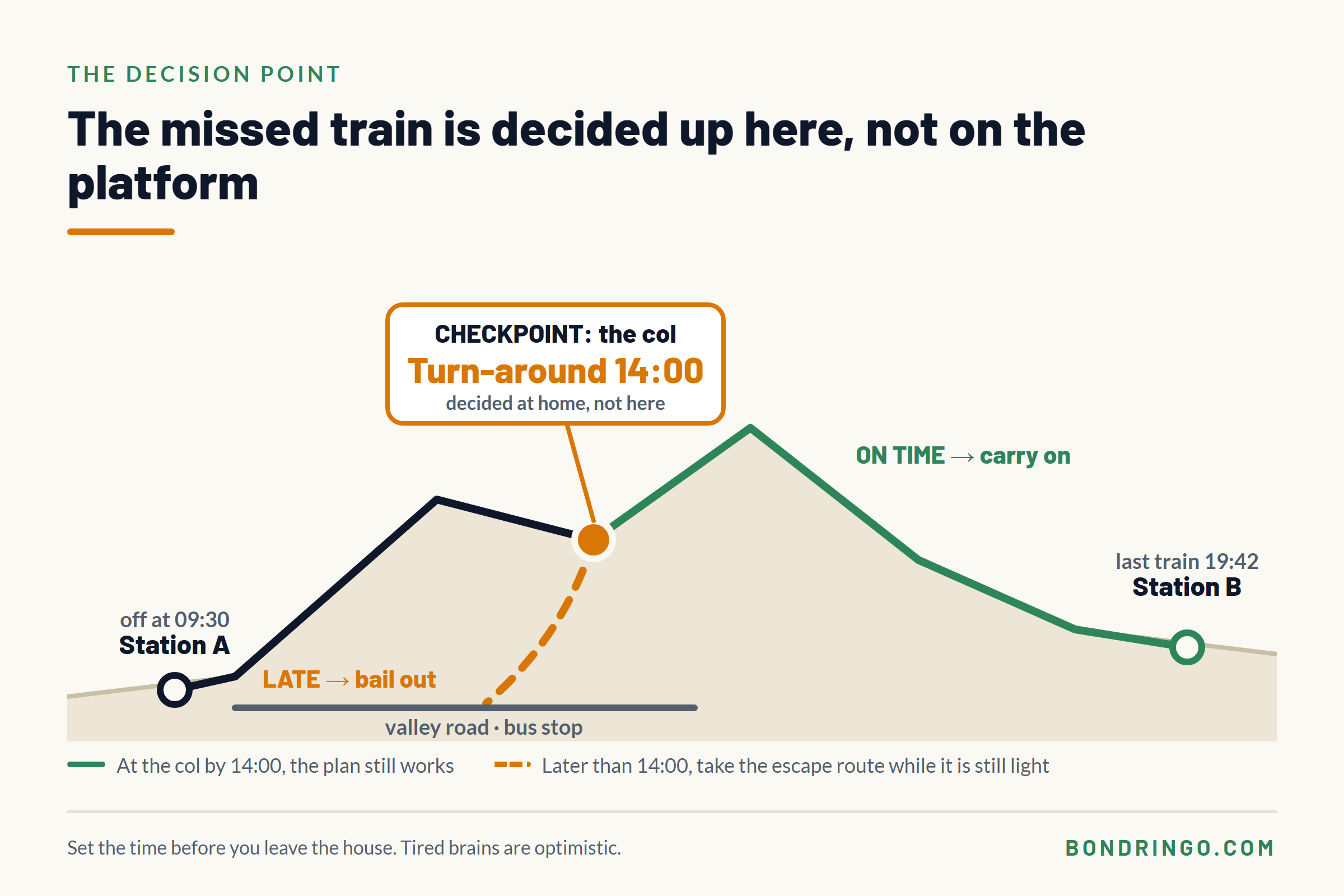
Here’s how to set one. Work out how long the walk takes, add on your stops, and count back from the train you intend to catch. Then pick a recognisable feature roughly halfway round, a col, a summit, a wall junction, and write down the time you need to be standing at it.
That’s it. If you’re there on time, carry on. If you’re late, you now have a decision to make while you still have options and daylight, which is exactly when decisions are cheap.
There’s a number worth knowing here. Mountain Rescue England and Wales recorded 3,784 callouts in 2024, and 78% of them came after 12 noon. The data tells you when teams get called, not why, so I won’t pretend to explain it. But it does say something plain about planning. The back half of the day is when things go wrong, and that’s the half people plan least carefully.
Right, You’ve Missed It. What Now?
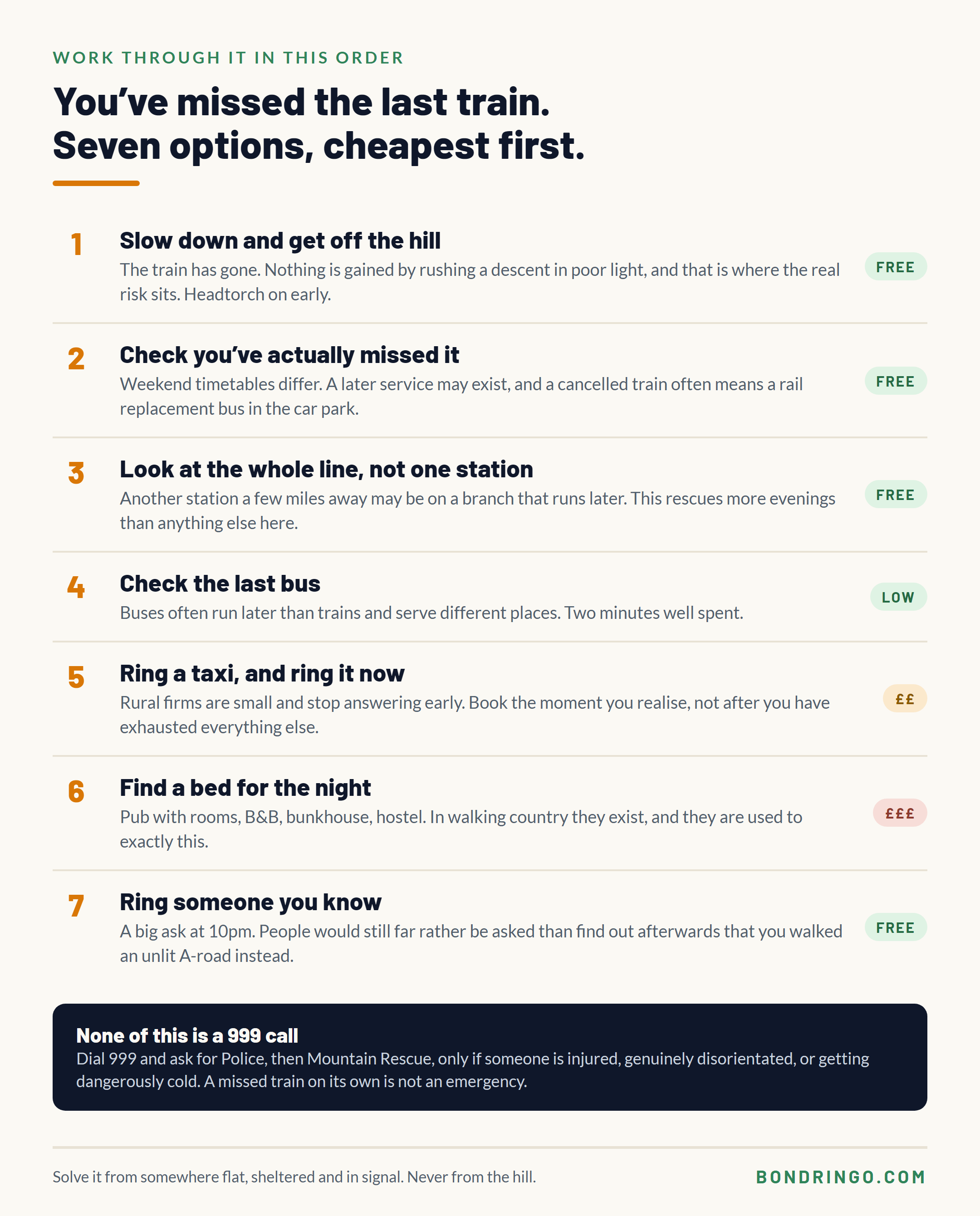
Okay, so the turn-around time has been and gone, or the train simply wasn’t there. Work through this in order.
1. Slow down. Whatever you do, don’t sprint a descent in poor light. Walking off the hill in the dark is the single point in the whole situation with real injury risk in it, and the train has already gone, so there is nothing to gain by hurrying. Headtorch on before you need it, not after.
2. Get down and get connected. Your priority is somewhere flat, sheltered and ideally with a phone signal. A station waiting room, a pub, a bus shelter, a village. Solve nothing while you’re still on the hill.
3. Check whether you’ve actually missed it. Genuinely check, don’t assume. Timetables on rural lines change at weekends, there may be a later service you didn’t clock, and if the train was cancelled rather than missed, a rail replacement bus may be sitting in the car park.
Cancellation also changes your position considerably. Under the National Rail Conditions of Travel, where disruption stops you completing your journey, the train company will, where it reasonably can, either arrange another way of getting you to your destination or provide overnight accommodation. So keep your ticket, note the time, and talk to staff or the operator’s app before you start spending your own money.
4. Look at the line, not just the station. You got off the hill at one point, but there may be another station on the same line within a few miles, on a branch that runs later. A short taxi to a bigger station has rescued more evenings than anything else on this list.
5. Ring for a taxi early. This is the big one, and the mistake people make is waiting. Rural taxi firms are small, often one or two cars, and they stop answering the phone early. Ring at the moment you realise, not once you’ve exhausted everything else. Yes, it’s expensive. It is still cheaper than a hotel and considerably cheaper than a night out in a bivvy bag.
6. Then a bed. Pub with rooms, B&B, bunkhouse, hostel. In walking country these exist and they’re used to exactly this.
7. Last, ring someone. A lift from a friend or family member is a big ask at 10pm, but people would far rather be asked than find out afterwards that you walked twelve miles of unlit A-road instead.
Never Feel Lost Again: The Free UK Navigation & Safety Pack
Stop relying solely on a fragile phone battery. Download the exact tools a professional outdoor instructor uses to stay safe in the British hills.

Enter your email below to get instant access to:
- NEW: The Hike Planning & Safety Checklist: A comprehensive pre-walk checklist to ensure you never leave a critical item behind or rely purely on a smartphone.
- The Emergency Protocol Guide: A highly structured, zero panic system detailing exactly what to do if lost on Dartmoor/Scottish hills, including when and how to call Mountain Rescue.
- The OS Map & Navigation Cheat Sheet: A quick reference guide to decoding complex map symbols and plotting grid references when your mind goes blank.
- The Route Card Template: The exact, logic-driven framework I use to plan foolproof expeditions and identify safe escape routes before leaving the house.
- The Timing Crib Card: Never misjudge daylight again. Master the mathematics of measuring pacing distance and timings for steep ground.
The Four Things That Turn a Late Finish Into a Rescue
Missing a train is survivable. These are the responses to it that aren’t.
Walking the road in the dark. Unlit rural roads with no pavement, a 60mph limit, hedges on both sides, and a driver who is not expecting a pedestrian.
If you absolutely must, do it the way the Highway Code says. Keep to the right-hand side so you can see oncoming traffic, walk in single file, and wear something reflective, which drivers can pick up in their headlights from up to three times the distance of ordinary clothing. On a sharp right-hand bend, cross well before it and cross back after, so nobody comes round the corner into you.
Hitching in the dark. Just don’t. You are hard to see, hard to assess, and in a poor position to choose who stops.
Pushing on over ground you can’t see. If your descent involves anything steep, loose or exposed and the light has gone, the correct answer may genuinely be to stop and sit it out somewhere sheltered until dawn. Uncomfortable is not the same as dangerous. Scottish Mountain Rescue recorded 57 mountaineering incidents during the hours of darkness in 2024.
If you do sit it out, get off the ground. Sit on your rucksack or a foam mat, because the cold ground will pull heat out of you far faster than the air will, and that single thing makes more difference than any amount of shuffling about. If there’s more than one of you, get in together under a group shelter or a bivvy bag and share the warmth.
Letting the cold win while you think. Standing still on a hill in the dark, damp with sweat, is how a nuisance becomes hypothermia. Put a dry warm layer on the moment you stop moving, before you feel cold rather than after.
Worth knowing what early hypothermia looks like, because it doesn’t announce itself. Instructors call them the umbles: grumbling, mumbling, fumbling and stumbling. The catch is that it affects judgement early, so the person going downhill is usually the last to accept it. If someone in your group gets quietly grumpy and clumsy, take that seriously rather than personally.
How to Plan So It Never Happens
Right, prevention. This is the part actually worth your ten minutes, because everything above is damage limitation.
Plan for the second-to-last train. This is the whole trick, and it’s the single most useful habit in car-free walking. Build the day around the penultimate service. The last train then stops being your target and becomes your safety net, which means an unexpectedly slow descent or a wrong turn costs you nothing at all.
Check the return before you commit to the route. Look at the last two services back on the actual day you’re going, not a generic weekday timetable. Sunday services on rural lines can be startlingly thin, and engineering works have a habit of landing on bank holiday weekends.
Write the times on your route card. Departure, the one before it, and your turn-around time. On the card, in your pocket, not in your head and not solely on a phone that might be dead by then.
Know your escape route before you need it. Every route worth walking has at least one point where you can bail into a valley, and the time to identify it is at the kitchen table. That’s a map skill, and it’s genuinely one of the more satisfying ones to learn.
Check the last bus too. Buses often run later than trains and go to different places. Worth two minutes.
Know what sunset actually is. Not roughly, precisely. In the UK it swings by several hours between midsummer and midwinter, and a route that’s comfortable in July is a night walk in October. Our summer hill walking tips piece covers how the long evenings change what’s realistic.
The Kit That Makes the Difference
You don’t need much, but these five things change the character of the night completely.
- A headtorch, and a spare set of batteries. Non-negotiable, all year round. A phone torch will flatten the one device you need for a taxi.
- A warm layer that is still dry. Kept in a bag, not worn all day.
- A power bank. Your phone is now your timetable, your taxi, your map and your way of telling someone where you are. If it’s getting low, put it in flight mode. It stops the phone hunting for a signal it can’t find, and GPS and downloaded offline maps carry on working. Keep it in an inside pocket too, because cold flattens a battery quickly.
- A bivvy bag. Costs very little, weighs almost nothing, and is the difference between a rough night and a dangerous one.
- Some cash. Rural taxi drivers and village pubs are not universally blessed with card machines or signal.
Most of that lives in a decent hill kit anyway. Our kit list for the hill has the full picture.
The Short Version
Missing the last train is a money problem, not a mountain problem, and it only becomes a mountain problem if you panic and rush.
Slow down. Get off the hill safely. Ring a taxi earlier than feels necessary. And next time, plan the day around the second-to-last train so the last one is spare.
That’s really it.
Frequently Asked Questions
Is missing the last train off the hill an emergency?
No. If you can walk, you know where you are, and nobody is injured or getting dangerously cold, it’s a logistics problem. Mountain Rescue is for people who can’t get themselves off the hill safely, not for people facing an expensive taxi. It becomes an emergency if injury, genuine disorientation or hypothermia enter the picture, and at that point you dial 999 and ask for Police, then Mountain Rescue.
What do you do if you get caught out in the dark hiking?
Stop and put your headtorch on before the light fully goes, not after. Add a dry warm layer while you’re still warm. Then slow right down, because most of the risk in a night descent is a slip on ground you’d walk over without a thought in daylight. If the remaining descent is steep, loose or exposed and you can’t see it properly, sitting it out somewhere sheltered until first light is a legitimate choice rather than a failure.
How do I work out a turn-around time for a walk?
Estimate how long the route takes, add your stops, and count backwards from the train or bus you need. Pick a clear feature about halfway round, a col, a summit or a wall junction, and write down the time you need to be standing there. If you arrive late, you take the escape route instead of continuing. Deciding this at home means the call gets made by a warm, rested version of you.
Is it safe to walk along a country road at night to get back?
It’s the option most likely to hurt you, so treat it as a last resort. Unlit rural roads have no pavement, a 60mph limit and drivers who aren’t expecting anyone on foot. If you have no alternative, walk facing oncoming traffic, wear something reflective, and keep your headtorch on full. A taxi almost always costs less than the risk.
What if the train was cancelled rather than missed?
That changes things in your favour. Check the car park for a rail replacement bus first, because operators frequently lay one on without much announcement. Beyond that, the National Rail Conditions of Travel say the train company will, where it reasonably can, either get you to your destination another way or put you up for the night. Hang on to your ticket and raise it with staff or the operator’s app rather than quietly booking your own hotel.
How can I avoid this happening in the first place?
Plan the day around the second-to-last service instead of the last one. That single change turns your final train from a target into a safety net, so a slow descent or a navigational error costs you nothing. Then check the actual timetable for the day you’re walking, note your escape route, and write both the train times and your turn-around time on your route card.
Get the Timing Right Before You Get the Train Wrong
Nearly everything in this article comes back to one skill, which is knowing how long the ground in front of you is actually going to take. Get that right and the last train stops being a source of anxiety.
That’s exactly what we teach, and you can start for nothing. The free Digital Safety Net course is sixteen lessons on making your phone genuinely reliable in the hills, including finding your position, getting a grid reference, and setting your kit up so a dead battery never becomes the reason you’re stuck somewhere in the dark.
Have you ever had to sort yourself out after missing the last one? Ask any questions in the comments below.


