

You’ve found a route, you know it’s twelve kilometres, and you have absolutely no idea whether that’s a morning or a whole day. So you guess, and then you’re still on the hill when the light goes.
Naismith’s Rule is the standard answer: allow one hour for every 5 kilometres of distance, plus one extra hour for every 600 metres of ascent. That’s it. On a 12km walk with 700m of climbing, you’d get roughly 2 hours 24 minutes for the distance plus about 1 hour 10 for the climb, so a shade over three and a half hours.
The catch is that the rule was written in 1892 for a fit Scottish mountaineer who apparently never stopped for lunch. Below is the rule, the three corrections that make it realistic, and how to turn it into a number you can actually trust.
What Naismith’s Rule Actually Says
William Naismith was a Scottish mountaineer, and in 1892 he offered a rule of thumb that has outlived nearly everything else from that decade.
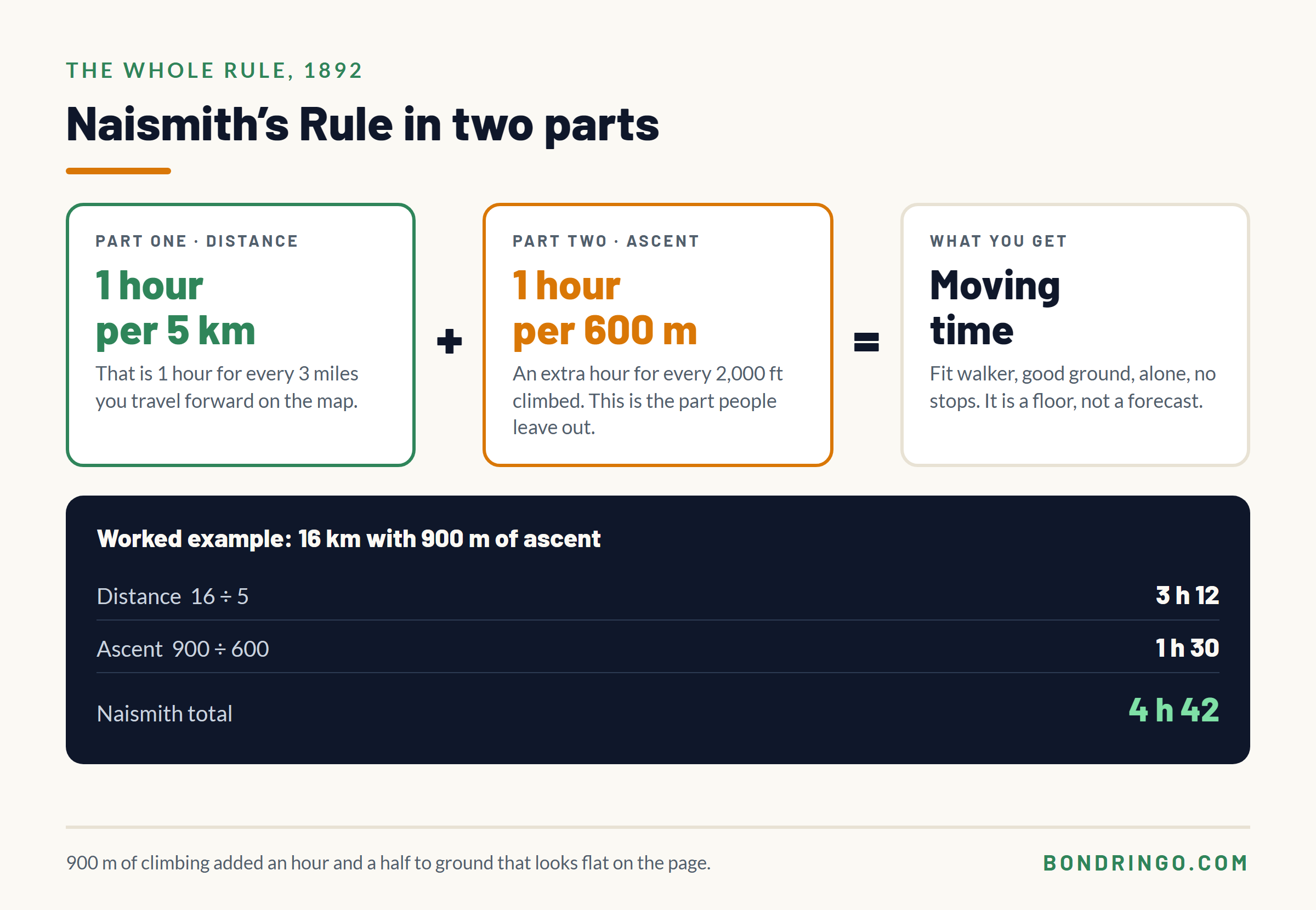
Allow one hour for every 3 miles (5 km) travelled, plus an additional hour for every 2,000 feet (600 m) of ascent.
That’s the whole thing. Two numbers, no lookup table, and you can do it in your head on the walk in.
Here’s it working on a real-shaped day. Say your route is 16 km with 900 m of ascent.
- Distance: 16 ÷ 5 = 3.2 hours
- Ascent: 900 ÷ 600 = 1.5 hours
- Naismith total: 4.7 hours, or 4 hours 42 minutes
Note what’s already interesting. That 900 m of climbing added an hour and a half, which is nearly a third of the day, for ground that on the map looks no longer at all. This is the single most useful thing the rule does. It stops you judging a walk by its length.
Why It’s Usually Optimistic
Naismith’s Rule is not wrong. It’s just describing a very specific day, and it probably isn’t yours.
Baked into it are the assumptions that you are reasonably fit, walking on decent ground, in good conditions, on your own, and not stopping. Change any of those and the number moves, usually upwards.
The stopping one catches everybody. The rule gives you moving time. It has nothing to say about lunch, photographs, layers on and off, gates, getting the map out, or standing about deciding which path is the right one.
So the honest way to describe Naismith’s output is this. It is the fastest the day could reasonably go, not the time it will take. Treat it as a floor and you’ll rarely be caught out.
The Corrections That Make It Realistic
Three people have since patched the gaps, and if you want the full set of formulas in one place, the Wikipedia entry on Naismith’s rule lays out Langmuir’s and Tranter’s corrections alongside the original. You don’t need all of them every time, but you should know which one applies to you.
Never Feel Lost Again: The Free UK Navigation & Safety Pack
Stop relying solely on a fragile phone battery. Download the exact tools a professional outdoor instructor uses to stay safe in the British hills.

Enter your email below to get instant access to:
- NEW: The Hike Planning & Safety Checklist: A comprehensive pre-walk checklist to ensure you never leave a critical item behind or rely purely on a smartphone.
- The Emergency Protocol Guide: A highly structured, zero panic system detailing exactly what to do if lost on Dartmoor/Scottish hills, including when and how to call Mountain Rescue.
- The OS Map & Navigation Cheat Sheet: A quick reference guide to decoding complex map symbols and plotting grid references when your mind goes blank.
- The Route Card Template: The exact, logic-driven framework I use to plan foolproof expeditions and identify safe escape routes before leaving the house.
- The Timing Crib Card: Never misjudge daylight again. Master the mathematics of measuring pacing distance and timings for steep ground.
Descent: the correction almost nobody knows
The original rule says nothing about going down, which is odd, because coming down is where the day frequently unravels.
Langmuir’s correction from 1984 splits it in two, and the split is counterintuitive.
- On a gentle descent of roughly 5 to 12 degrees, subtract 10 minutes for every 300 m of descent. You genuinely go faster downhill.
- On a steep descent of more than 12 degrees, add 10 minutes for every 300 m of descent.
Read that again, because it’s the bit people get wrong. Steep downhill costs you time, it doesn’t save it. Anyone who has picked their way down a loose, steep 400 metres knows this in their knees. On Langmuir’s figures that descent adds about 13 minutes rather than saving any, which is why a route that looks like an easy finish on the map can quietly run late.
Groups: the correction most people need
If you’re walking with other people, this is the one that matters, and it’s a bigger adjustment than most walkers expect.
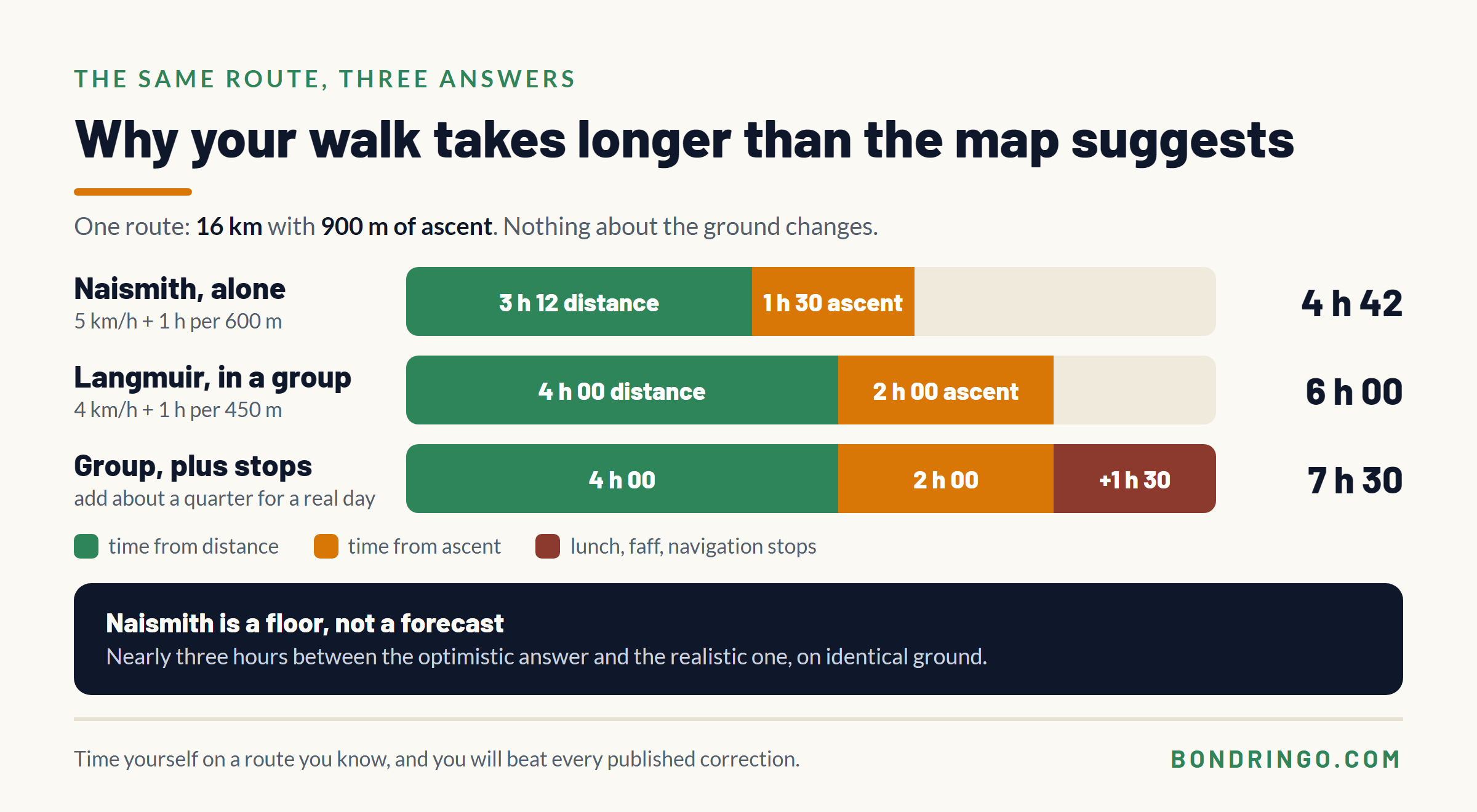
Langmuir suggests that for a group you use 4 km/h plus one hour per 450 m of ascent, rather than Naismith’s 5 km/h and 600 m.
Run our 16 km, 900 m day through that instead.
- Distance: 16 ÷ 4 = 4 hours
- Ascent: 900 ÷ 450 = 2 hours
- Group total: 6 hours
Against Naismith’s 4 hours 42. That’s nearly an hour and twenty minutes longer, on identical ground, purely because there are several of you. Groups stop more, spread out, and move at the pace of whoever is having the worst day.
If you plan a group day on the solo number, you will miss things. This is probably the single most common timing error in UK hill walking.
Fitness and fatigue
Tranter’s corrections adjust for how fit you actually are, measured by how long it takes you to climb 1,000 feet over half a mile. Fifteen minutes counts as very fit, fifty as unfit, and there’s a table in between.
The scale of the adjustment is the eye-opener. A route Naismith puts at 9 hours becomes 11 and a half hours for someone in the middle of that fitness range. Two and a half hours of difference from the same route description.
You don’t need the table. You need the point behind it, which is that the rule was written for someone quite fit, and if that isn’t you today, the number is not yours.
Three more adjustments worth carrying
These are working figures rather than published formulas, but they’re the ones that come up most often in practice.
A heavy pack slows you down. A useful planning figure is to knock roughly a kilometre an hour off your flat speed when you’re carrying a full multi-day load. It’s a rule of thumb rather than a measured constant, so treat it as a nudge in the right direction.
Darkness slows you down a lot. Plan on being much slower once the headtorch is on, and on rough ground something near half your daytime pace is a sensible assumption. This matters more than people expect, because the dark usually arrives at the end of the day, when you’re already behind.
You can trade climb for distance. A widely used rule of thumb says 100 metres of ascent costs you about the same as 1 kilometre of flat walking, which is a quick way to compare a long gentle route against a short steep one. Worth knowing that the research puts the real ratio closer to 8 to 1 than 10 to 1, so use it for choosing between options rather than for calculating a time.
What the Formula Never Includes
None of these rules cover the stuff that actually fills a day. Add it yourself.
- Lunch and stops. Be honest. Most people stop for longer and more often than they think.
- Navigation stops. Every time the map comes out, that’s a minute or two. In poor visibility it’s a great deal more.
- Bad ground. Deep heather, peat hags, boulder fields and tussocks can halve your speed and none of it shows on the map.
- Gates, stiles and livestock. Trivial individually, not trivial forty times.
- River crossings. Either quick or an enormous detour, and you often can’t tell which until you’re there.
- Faff. Layers, boots, blisters, the photograph, the conversation about which way to go.
A rough working figure many instructors use is to take your calculated time and add a quarter on top for a normal day out with stops. It isn’t scientific. It’s usually closer than the raw number.
Calibrating It to You
Here’s the part that turns this from trivia into a skill you own.
Time yourself on a route you already know. Pick something local, note the distance and the ascent, and record how long it genuinely took you door to door, stops included.
Then work out your own multiplier. If Naismith said 4 hours and you took 5, your personal factor is roughly 1.25. Do that three or four times on different routes and you’ll have a number that beats every published correction, because it describes you rather than a Victorian mountaineer.
That number will move about with terrain, weather and company, and it should. But knowing that you personally run at “Naismith plus a quarter” is worth more than memorising three sets of corrections.
If you want a way to practise this deliberately, our guide to practising navigation without getting lost covers timing and pacing calibration as specific drills.
Working Backwards From a Deadline
Most of the time you’re not asking “how long will this take”. You’re asking “can I get back in time”.
That flips the calculation, and it’s where timing stops being an academic exercise. It matters most on public transport, where the last train is a genuinely fixed point. If you’re walking in the UK hills without a car, this is the whole game.
If you would rather not do the arithmetic, the walk time calculator does all of this for you: put in the distance and ascent, or tap a mountain, give it the time you need to be back, and it tells you when to leave and when to turn round.
Work it like this.
1. Start from the service you need, and use the second-to-last one, not the last.
2. Subtract your corrected walk time, group and fatigue adjustments included, plus your stops.
3. Subtract a buffer. Half an hour minimum. An hour if the consequences of being late are expensive.
4. That’s your departure time. If it’s unrealistically early, the route doesn’t fit today.
5. Set a turn-around time at a midway feature so you find out you’re behind while you still have options.
That last one is what converts a calculation into a decision you can actually act on. If it goes wrong anyway, what to do if you miss the last train off the hill covers the rest.
The Short Version
Naismith’s Rule is one hour per 5 km, plus one hour per 600 m of ascent, and it is the fastest your day could reasonably go rather than the time it will take.
Add Langmuir’s group figures if you’re not alone, because that correction is bigger than people expect. Remember that steep descent costs time rather than saving it. Then add a quarter for the stops nobody puts in the formula.
And time yourself on a route you know, so that eventually you stop needing the rule at all.
Frequently Asked Questions
What is Naismith’s Rule?
It’s a rule of thumb for estimating how long a hill walk will take, devised by the Scottish mountaineer William Naismith in 1892. Allow one hour for every 3 miles or 5 kilometres of distance, then add an extra hour for every 2,000 feet or 600 metres of ascent. Its real value is that it forces you to account for climbing, which is the part people consistently ignore when they judge a walk by its length alone.
Is Naismith’s Rule accurate?
It’s accurate for what it describes, which is a reasonably fit person moving steadily on good ground without stopping. That is not most days. It takes no account of breaks, rough terrain, poor weather, walking in a group or being tired, so treat the answer as the fastest the day could go rather than the time it will take.
How do I adjust Naismith’s Rule for a group?
Use Langmuir’s group figures instead: 4 km/h plus one hour per 450 metres of ascent, rather than 5 km/h and 600 metres. On a 16 kilometre route with 900 metres of ascent that turns roughly 4 hours 40 into 6 hours. Groups genuinely are that much slower, because they stop more often and move at the pace of whoever is struggling most.
Does going downhill save time?
Only sometimes, and this catches people out. On a gentle descent of about 5 to 12 degrees you can subtract 10 minutes per 300 metres of descent. But on anything steeper than 12 degrees you should add 10 minutes per 300 metres instead. Steep descent is slow, hard on the legs and a common place for the day to overrun.
How much extra time should I add for breaks?
None of the standard rules include stops at all, so you have to add them yourself. A practical approach used by many instructors is to add about a quarter on top of the calculated time for a normal day with lunch and a few stops. Better still, time yourself over a couple of familiar routes and work out your own factor, because that will describe you far more accurately than any general correction.
How do I plan a walk around a fixed deadline?
Work backwards rather than forwards. Start from the train or bus you need, use the second-to-last service so the last one is a safety net, subtract your corrected walking time and your stops, then subtract a buffer of at least half an hour. What remains is your latest sensible start time. Then set a turn-around time at a recognisable feature about halfway round, so you learn you are behind schedule while you still have choices.
Get the Timing Right and the Rest Follows
Timing is one of those skills that looks like arithmetic and is really about judgement. The formula takes five minutes to learn. Knowing what to add for your legs, your group and the ground under your feet is the bit that takes a few walks.
If you want a structured place to build that, the free Digital Safety Net course is sixteen lessons on getting your planning and your phone genuinely reliable before you set off. It costs nothing and it’s the right foundation for all of this.
So, next walk: work out your Naismith number before you go, then time yourself and see how far out it was. What’s your personal factor? Ask any questions in the comments below.


