

You’ve decided to sort your navigation out before your next trip north, and now you’re stuck between booking two days in the Cairngorms and doing something from home.
They do different jobs, and the honest answer for most people is both, in that order. Online teaches you the system, cheaply, and lets you revisit it before every walk. In-person gives you a qualified instructor watching you navigate real ground and telling you what you’re actually doing wrong. What you cannot do is skip the first and expect the second to stick.
Below is what Scottish ground genuinely demands, what each kind of training does well, what it really costs once you add everything up, and how to tell which one you need first.
What Makes Scottish Navigation Different
This matters more than the choice of course, because it decides what you actually need to learn.
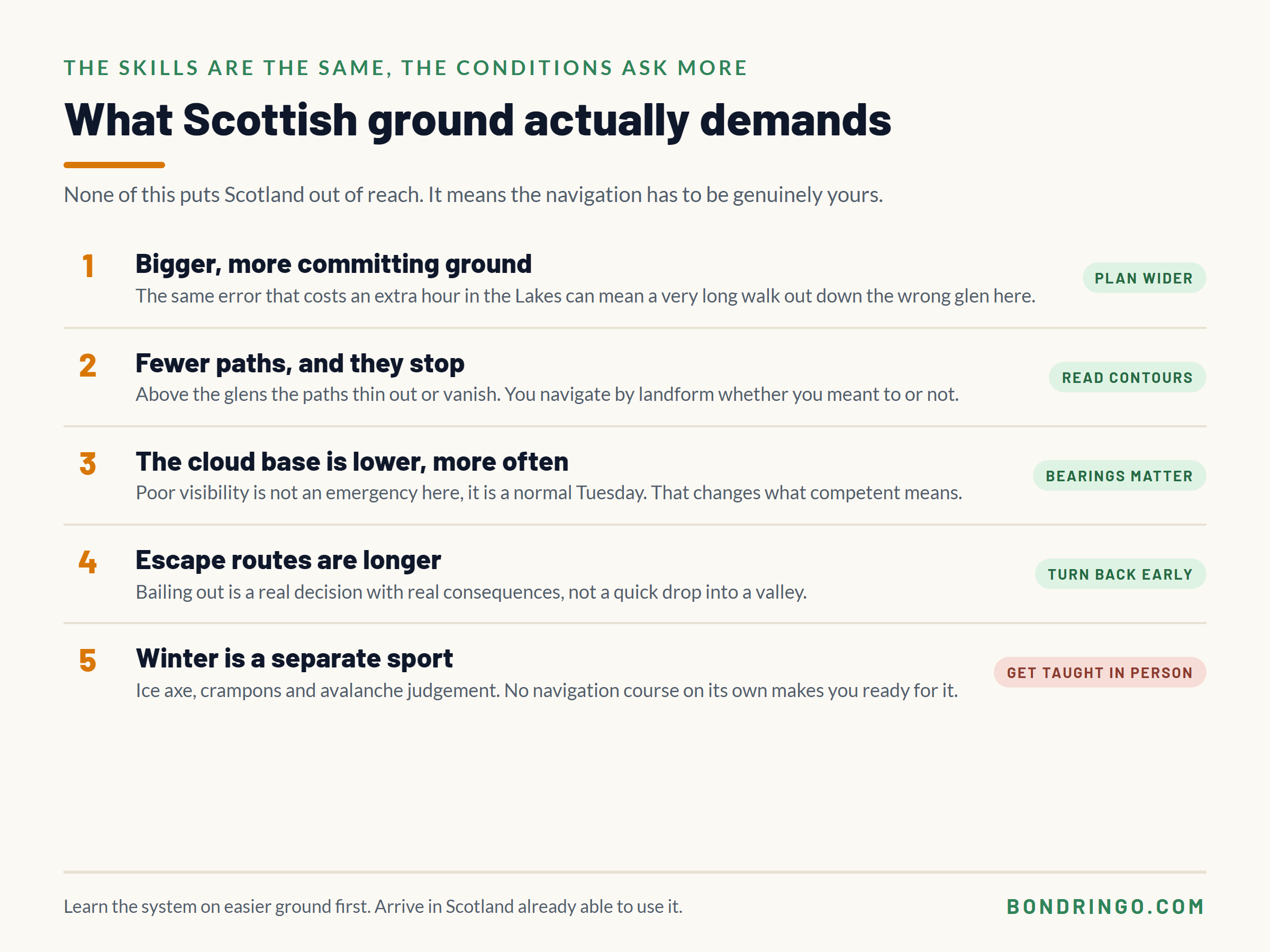
The ground is bigger and more committing. A navigational error in the Lakes usually means an annoying extra hour. The same error in the Monadhliath or on the Cairngorm plateau can mean a very long walk out in the wrong glen, with no road and no phone signal at the end of it.
There are fewer paths, and they stop. A lot of English hill walking is path-following with occasional navigation. Above the glens in Scotland, paths thin out or vanish entirely, and you are navigating by landform whether you meant to or not.
The cloud base is lower more often. You will use poor-visibility skills in Scotland. Not as an emergency, as a normal Tuesday. That single fact shifts what “competent” means.
Escape routes are longer. Bailing out is a real decision with real consequences rather than a quick drop into a valley, which puts far more weight on planning and on turning back early.
Winter is a separate sport. Scottish winter needs an ice axe, crampons, avalanche awareness and the judgement to use all three. No navigation course, online or otherwise, makes you ready for that on its own.
None of this makes Scotland off-limits. It does mean the navigation has to be genuinely yours rather than something you half-remember.
What In-Person Training in Scotland Gives You
Let’s be straight about this, because there are things an instructor standing next to you can do that a screen simply cannot.
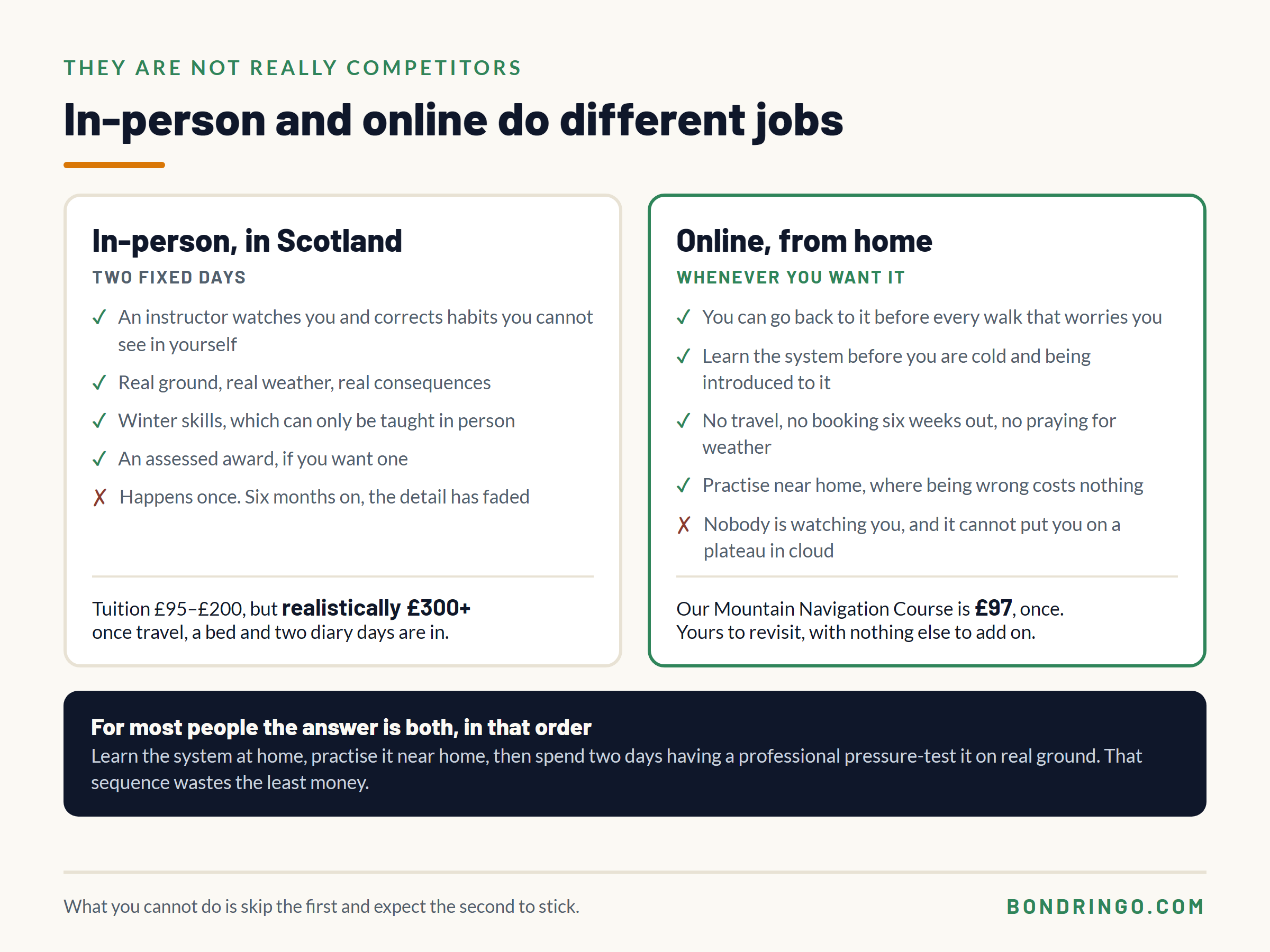
Someone watches you and corrects what you actually do. This is the big one. You can believe you are setting the map and taking a clean bearing, and be quietly making the same error every time. A good instructor spots it in ten minutes.
Real ground, real weather, real consequences. Practising relocation in cloud on the Cairngorm plateau with a professional beside you is a genuinely different experience from reading about it.
Winter skills have to be taught in person. Ice axe, crampons and avalanche judgement are not learnable from a screen, and nobody sensible claims otherwise.
A formal award, if you want one. If you want an assessed qualification, that means an in-person provider. The National Navigation Award Scheme runs Bronze, Silver and Gold awards through registered providers, and they require assessed performance outdoors. An online course cannot award one, and any that implies it can is worth being suspicious of.
Scotland is unusually well served here. Glenmore Lodge, near Aviemore, is Scotland’s national outdoor training centre and runs navigation, hill skills and winter courses, and there are NNAS providers and independent qualified instructors and guides across the Highlands. If you want assessed, residential, Scottish-specific training, the options are genuinely excellent.
Worth knowing too that Mountaineering Scotland runs subsidised navigation courses for members, including night navigation and winter navigation. If cost is what has been stopping you booking something in person, that is the first place to look rather than the last.
What Online Training Gives You
Different strengths, and they are not lesser ones.
You can go back to it. This is the thing people underestimate. A two-day course happens once, and six months later you are trying to remember what the instructor said about aiming off. An online course sits there, and you can watch the relocation lesson the night before a walk that worries you.
It costs a fraction as much. More on the real numbers below.
It fits around your life. No two fixed diary days, no travel, no booking six weeks ahead and praying for weather.
You learn the system before you’re cold. Turning up to an in-person course already understanding what a bearing is means you spend the two days practising rather than being introduced. Instructors much prefer this, and you get far more out of the money.
You can practise at your own pace, near home. Most of navigation is learnable on ground you already know, which is exactly what we cover in how to practise navigation without getting lost.
What online genuinely cannot do is watch you and correct you, or put you on a Scottish plateau in cloud. Anyone telling you otherwise is selling.
Never Feel Lost Again: The Free UK Navigation & Safety Pack
Stop relying solely on a fragile phone battery. Download the exact tools a professional outdoor instructor uses to stay safe in the British hills.

Enter your email below to get instant access to:
- NEW: The Hike Planning & Safety Checklist: A comprehensive pre-walk checklist to ensure you never leave a critical item behind or rely purely on a smartphone.
- The Emergency Protocol Guide: A highly structured, zero panic system detailing exactly what to do if lost on Dartmoor/Scottish hills, including when and how to call Mountain Rescue.
- The OS Map & Navigation Cheat Sheet: A quick reference guide to decoding complex map symbols and plotting grid references when your mind goes blank.
- The Route Card Template: The exact, logic-driven framework I use to plan foolproof expeditions and identify safe escape routes before leaving the house.
- The Timing Crib Card: Never misjudge daylight again. Master the mathematics of measuring pacing distance and timings for steep ground.
What It Actually Costs
Worth being honest about, because the headline price is not the cost.
In-person. A two-day navigation course in the UK typically runs somewhere between £95 and £200. But that is the course fee alone. Add travel to the Highlands, two nights somewhere, food, and two fixed days out of your diary, and the realistic all-in figure for most people is £300 or more. Residential courses bundle the accommodation and food, which is convenient and reflected in the price.
Online. Our Mountain Navigation Course is £97, once. No travel, no accommodation, no diary days, and it’s there before every walk rather than on one weekend in April.
The point is not that one is better value. It’s that they buy different things. £300 buys two days of expert attention on real ground. £97 buys a system you keep and can revisit indefinitely.
For most people, spending the smaller amount first and the larger amount later, if at all, is simply the better order.
Which One Do You Actually Need?
Here’s the honest sort.
Start online if you are new to navigation, you want to build confidence before committing money and a weekend, you walk mostly in summer, or you learn better by revisiting things than by being told once.
Go in-person if you want an assessed award, you are heading into Scottish winter, you have plateaued and suspect you have a bad habit you cannot see, or you simply learn best with someone watching you.
Do both, in that order, if you want the most out of your money. Learn the system at home, then spend two days having a professional pressure-test it on real ground. That is the sequence that wastes the least.
A useful step before you spend anything: our free Navigation Test is twenty-three questions with no signup, and it will show you fairly quickly whether your gap is the basics or poor-visibility work. That changes which of the two options above is the better buy.
And if what you are really asking is whether you are ready to go out and use any of it, our honest self-assessment for walking alone is a more useful guide than a course brochure.
A Few Scotland-Specific Things Worth Knowing
Not about courses, but they’ll shape your trip.
Access law is different, and better. Scotland has a statutory right of responsible access under the Land Reform (Scotland) Act 2003, which is a genuinely different legal position from England and Wales. We cover the detail in our guide to UK trail access and the law.
Munro-bagging shapes the paths. Popular Munros have worn paths; neighbouring hills of similar quality often have none at all. Do not assume a path exists because the hill looks similar on the map.
Timing needs more margin. Longer approaches, rougher ground and less path mean Naismith’s Rule needs generous handling. Which is fitting, given Naismith was a Scottish mountaineer.
Burns come up fast. A stream you stepped across on the way out can be an impassable torrent on the way back after a few hours of rain. Anything drawn on the map as a double line should be treated as uncrossable in spate, and it is worth knowing before you set out whether your route depends on a crossing.
It gets colder faster than you expect. Air temperature falls roughly one degree for every hundred metres you climb, so a mild glen and a bitter summit are entirely normal on the same afternoon.
Midges are real, and they are a summer problem. A head net weighs nothing and will save your evening.
Check the avalanche forecast in winter, every time, without exception. The Scottish Avalanche Information Service forecasts six areas, including Lochaber, Glencoe and both Cairngorms, through the winter season.
The Short Version
In-person and online navigation training are not really competitors. One teaches you the system cheaply and permanently, the other has an expert watch you use it.
If you are heading for Scottish hills in summer and you’re new to this, learn the system first, practise it near home, and go. If you want an award, or you’re going in winter, book someone qualified in Scotland.
The mistake is doing neither and hoping the phone holds out.
Frequently Asked Questions
Are online navigation courses as good as in-person ones in Scotland?
They are good at different things. Online teaches the system thoroughly and lets you revisit it before every walk, which matters because skills fade. In-person puts a qualified instructor on real ground with you, watching what you actually do and correcting habits you cannot see in yourself. For summer hill walking most people get further, faster, by learning online first and then booking in-person if they want assessment or winter skills.
Do I need a navigation qualification to walk in Scotland?
No. There is no requirement to hold anything to walk in the Scottish hills. Awards like the National Navigation Award Scheme are useful if you want your competence formally assessed, or if you are working towards leading groups, but they are not needed for personal walking. What matters is that you can genuinely do it, not that you can prove it.
Where can I do a navigation course in Scotland?
Glenmore Lodge near Aviemore is Scotland’s national outdoor training centre and runs navigation, hill skills and winter courses. Beyond that there are registered National Navigation Award Scheme providers and independent qualified instructors and mountain guides working across the Highlands. If you want winter skills specifically, look for providers running courses in the Cairngorms or Lochaber between roughly December and April.
How much does a navigation course cost in Scotland?
A two-day UK navigation course generally falls between £95 and £200 for the tuition. The real figure is higher once you add travel to the Highlands, accommodation, food and two fixed days off, which typically takes it past £300. Residential courses include the accommodation and meals, so the headline price is higher but covers more. Online courses cost considerably less and have no travel or accommodation attached.
Is Scottish navigation harder than the rest of the UK?
The skills are identical. The conditions ask more of them. Scottish hills are bigger, paths are fewer and stop sooner, cloud sits lower more often, and escape routes are longer, so poor-visibility navigation becomes routine rather than exceptional. Winter changes it again into a different activity requiring an ice axe, crampons and avalanche judgement.
Should I learn navigation before going to Scotland or after?
Before, and ideally on easier ground closer to home. Scottish terrain is a demanding place to be learning the basics for the first time, and the consequences of a mistake are larger there. Learn the system, practise it somewhere familiar where being wrong costs nothing, and arrive in Scotland already able to use it.
Learn the System First, Free
Whichever way you eventually go, the thing that makes everything else work is having the basics genuinely in your head before you’re standing in the cloud.
The free Digital Safety Net course is sixteen lessons on getting your phone and your planning properly reliable, which is the foundation the rest sits on. It costs nothing, and it will tell you fairly quickly whether you want to go further.
So, in-person or online for you? And which hills are you heading for? Ask any questions in the comments below.


