

Search for a free online navigation course and you’ll find plenty. Articles, videos, forum threads, and a fair few actual courses, including ours.
Here’s the honest answer on what you get free. Free content is very good at teaching you what to do. It’s much weaker at teaching you how, in the right order, and at telling you whether you’ve actually understood it. You can absolutely learn real navigation without spending anything. What you’re paying for, when you pay, is sequence, assessment and someone to ask.
In this guide we’re going to be straight about where the line sits. What’s genuinely worth learning for free, what’s in our own free course, where free content lets you down, and when paying is actually justified.
What You Can Genuinely Learn for Free
Quite a lot, and I’d rather say so than pretend otherwise.
The individual skills are all documented somewhere. How to take a bearing, what contour lines mean, how grid references work. None of this is secret, and plenty of it is explained well. Ordnance Survey’s own guides are genuinely good and cost nothing.
Kit knowledge is basically free. What sort of compass to buy, which map scale to use, how to keep a map dry. You do not need to pay anyone for this.
And you can practise for free. This is the part people miss. Once you know what a bearing is, walking one in a local park costs nothing at all, and it’s the practice that makes the skill stick rather than the explanation.
If you’re motivated, organised and prepared to piece it together yourself, you can get a long way without spending money. I’d rather you did that than didn’t go out at all.
What’s Actually in Our Free Course
Since we run one, it’s only fair to tell you exactly what it is rather than being vague about it.
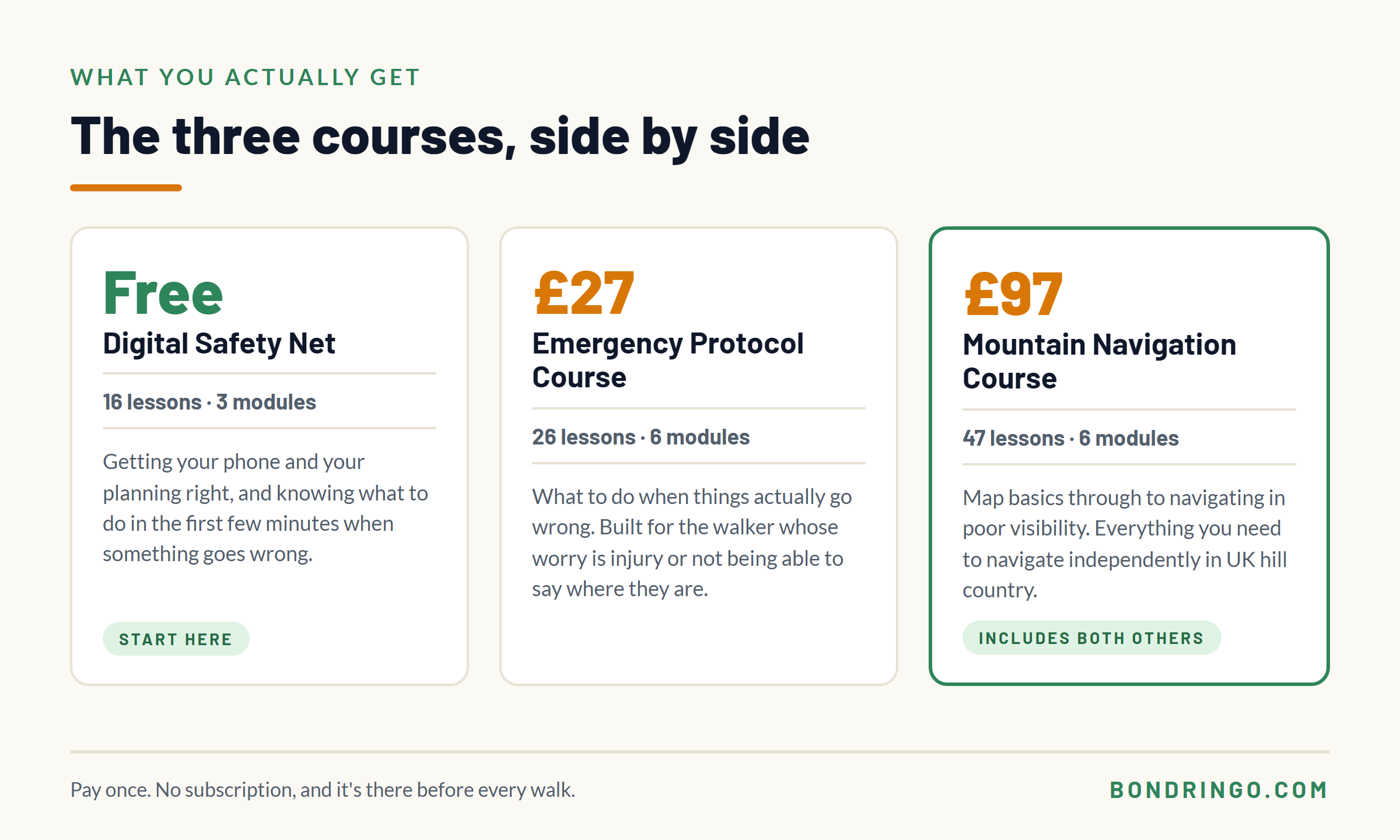
The Digital Safety Net is 16 lessons across 3 modules, and it’s genuinely free. Email address, instant access, no card details.
It covers the preparation layer, the things that go wrong before navigation even becomes the problem:
– Setting your phone up so it survives a full day out – Downloading offline maps properly, so they work without signal – Registering for the emergency SMS service before you need it – Setting up medical ID on your phone – Finding and reading your grid reference so you can say where you are – What to actually do in the first few minutes when something goes wrong
That’s a real and useful body of knowledge, and it’s the bit most beginners are missing. It is not a full navigation course, and I’m not going to describe it as one.
Where Free Content Falls Down
Right, here’s the honest part, and it isn’t about quality. Plenty of free material is excellent. It’s about structure.
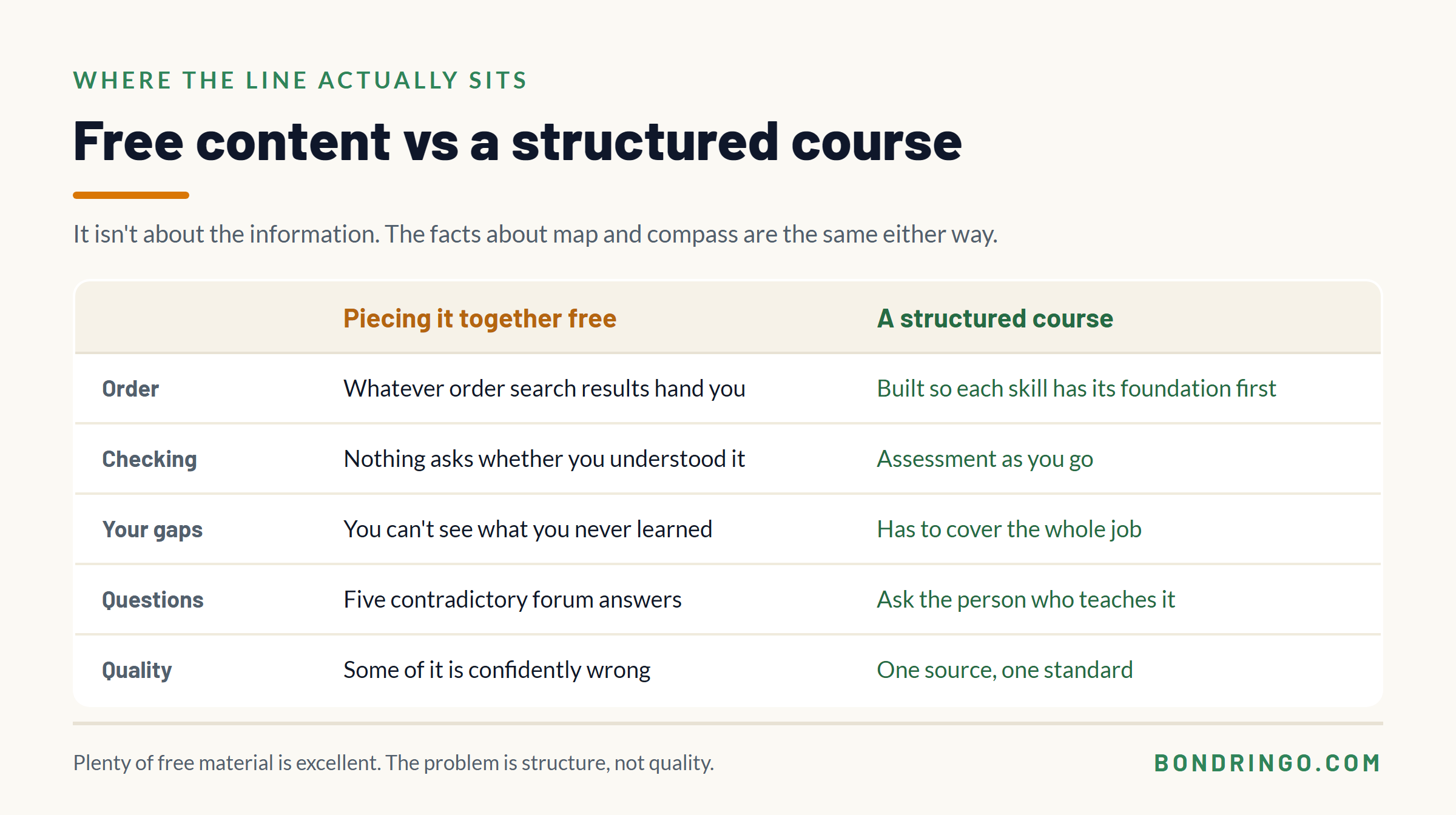
There’s no order. Navigation skills build on each other. Contours before relocation. Grid references before you can report a position. Piecing free content together means you meet things in whatever order the search results hand them to you, which is rarely the order that makes them click.
Nothing tells you whether you’ve understood it. You read an article on taking a bearing, it makes sense, you close the tab. Whether you could actually do it on a hillside in wind is a completely different question, and nothing in that process asks you.
You can’t see your own gaps. This is the big one. You don’t know what you haven’t learned. It’s a common pattern: someone perfectly confident with a compass who has never once thought about how long a route will take, because nothing they read ever raised it as a question.
Nobody answers your question. When you’re stuck on the specific bit that’s confusing you, free content has no mechanism to help. You post on a forum and get five contradictory answers from people who can’t see your map.
And quality varies enormously. Some free advice is out of date, some is regional, and some is confidently wrong. Without the background to judge it, you can’t tell which is which.
Never Feel Lost Again: The Free UK Navigation & Safety Pack
Stop relying solely on a fragile phone battery. Download the exact tools a professional outdoor instructor uses to stay safe in the British hills.

Enter your email below to get instant access to:
- NEW: The Hike Planning & Safety Checklist: A comprehensive pre-walk checklist to ensure you never leave a critical item behind or rely purely on a smartphone.
- The Emergency Protocol Guide: A highly structured, zero panic system detailing exactly what to do if lost on Dartmoor/Scottish hills, including when and how to call Mountain Rescue.
- The OS Map & Navigation Cheat Sheet: A quick reference guide to decoding complex map symbols and plotting grid references when your mind goes blank.
- The Route Card Template: The exact, logic-driven framework I use to plan foolproof expeditions and identify safe escape routes before leaving the house.
- The Timing Crib Card: Never misjudge daylight again. Master the mathematics of measuring pacing distance and timings for steep ground.
What You’re Actually Paying For
Not information. The information is free and it always will be.
You’re paying for four things.
Sequence. Skills introduced in an order that builds, so each one has the foundation it needs before it arrives.
Assessment. Something that checks whether you’ve understood, rather than leaving you to assume.
Completeness. A course has to cover the whole job. Free articles cluster around the questions people actually search for, which leaves the unglamorous middle of the subject thinly covered.
Someone to ask. Being able to put your specific question to someone who teaches this, rather than guessing.
Our paid courses are the Emergency Protocol Course at £27, which is 26 lessons across 6 modules on what to do when things go wrong, and the Mountain Navigation Course at £97, which is 47 lessons across 6 modules and takes you from map basics to navigating in poor visibility. The £97 course includes both of the others.
How the Cost Actually Compares
Worth putting this in context, because £97 sounds like a lot until you look at the alternative.
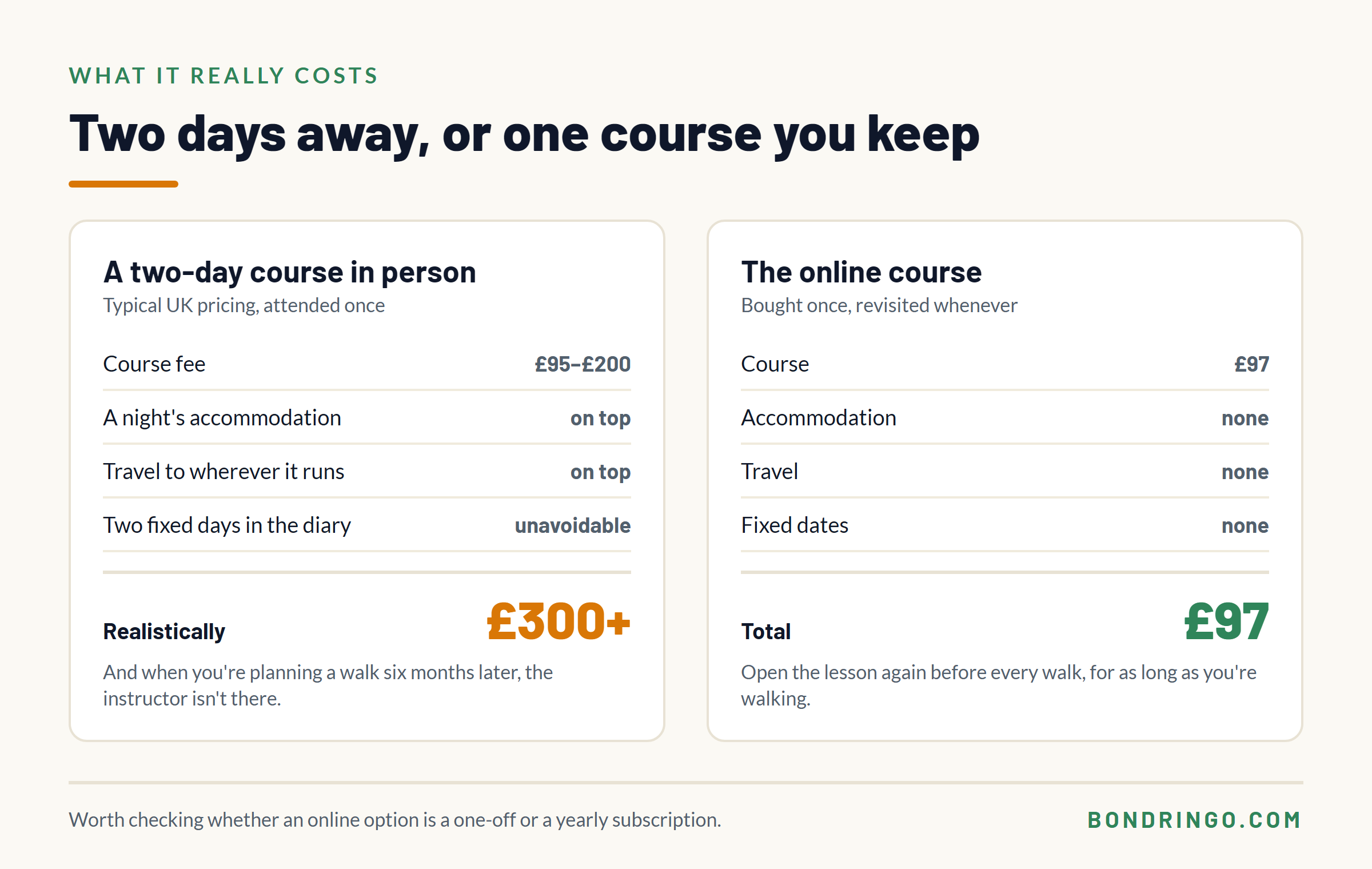
A two-day navigation course in the UK typically costs somewhere between £95 and £200 for the course fee alone. Then add accommodation for the night in between, travel to wherever it’s running, and two fixed days in the diary that you have to be free for. Realistically you’re at £300 or more, once.
And that’s the word that matters. Once. You attend, you learn a lot, and six months later when you’re actually planning the walk, the instructor isn’t there.
An online course you’ve bought is there before every walk. Forgotten how to do something? Open the lesson again. That’s a genuinely different relationship with the material.
The other thing worth checking when you compare options is whether you’re buying it or renting it. Pay once, not every year is a real difference over time, and it’s easy to miss when you’re looking at a monthly figure.
So Which Should You Actually Start With?
Here’s how I’d genuinely advise it.
Start free. Take the free course, read widely, and get out and practise. If that’s enough for the walking you want to do, that’s a completely legitimate place to stop, and plenty of people should.
Consider the £27 course if your worry is things going wrong rather than route-finding. If what keeps you up is “what if someone gets hurt” or “what if I can’t say where I am”, that’s what it’s built for.
Consider the £97 course if you want to navigate independently in proper hill country, including in poor visibility, and you’d rather learn it properly than assemble it yourself over two years.
And if you’re not sure, stay free for now. You’ll know when you hit the ceiling, because you’ll find yourself repeatedly unsure about the same thing.
Is there a genuinely free online navigation course?
Yes. Ours is the Digital Safety Net, 16 lessons across 3 modules, free with an email address and no card details. It covers preparation and what to do when something goes wrong, rather than the full navigation syllabus. There’s also a large amount of good free material elsewhere, including Ordnance Survey’s own guides, so you can learn a great deal without spending anything.
Can you learn navigation properly without paying?
You can, if you’re organised and persistent. Every individual skill is documented somewhere for free. What’s hard without a course is knowing the right order to learn things in, checking whether you’ve genuinely understood something, and spotting the gaps you don’t know you have. Those are the things people are actually buying when they pay.
What’s the difference between a free and a paid navigation course?
Usually structure rather than information. A free course tends to cover a slice of the subject, often the introductory part. A paid course has to cover the whole job in a deliberate order, check your understanding as you go, and give you a way to ask questions. The underlying facts about map and compass are the same either way.
How much does an online navigation course cost?
Ours are £27 for the Emergency Protocol Course and £97 for the Mountain Navigation Course, which includes the other two. For comparison, a two-day in-person UK navigation course generally runs between £95 and £200 in course fees, before you add travel and accommodation. Worth also checking whether an online option is a one-off purchase or a recurring subscription, because that changes the real cost considerably over a few years.
Do I need to pay to learn to use a compass?
No. Taking a bearing is a well-documented skill and you can learn it from free material, then practise it in a local park at no cost. What free content won’t do is tell you whether you’re doing it correctly, or cover what happens when the bearing takes you across ground you can’t see.
Is a free navigation course enough for UK hill walking?
It depends entirely on where you’re going. For waymarked paths in good conditions, solid preparation and basic map reading go a long way. For open hill country, poor visibility, or anywhere you’d have to relocate yourself if you drifted off route, you need the full skill set, and free content rarely delivers that as a coherent whole.
Start Where It Costs You Nothing
If you’ve read this far, the sensible next step is the free one.
Our free Digital Safety Net course takes about an hour in total and covers the preparation most people are missing. No card, no commitment, and if it turns out to be all you need then that’s a good outcome.
If you’d rather work out which level actually fits you first, the nav skills quiz takes a couple of minutes and points you at the right starting place.
Have a go at this. Before you buy anything at all, write down the three navigation situations that genuinely worry you. If free material answers all three, you’re done. If it doesn’t, you now know exactly what you’d be paying to fix.
Ask any questions in the comments below.


