

You’ve found two walks of about the same distance. One loops back to the car park, the other finishes in a different valley. People will tell you the linear one is harder. It’s worth being precise about why, because a lot of what gets said about point to point vs circular walks doesn’t survive much thought.
Here’s the honest answer. There is really only one difference, and everything else follows from it: a circular walk returns you to your transport, and a linear one doesn’t. That makes two things genuinely harder, creates a pile of logistics, and changes nothing at all about several things people assume it changes.
In this guide we’re going to separate those out. What a loop actually gives you, what genuinely gets harder on an A-to-B route, and the differences that turn out not to be differences.
The Difference in One Sentence
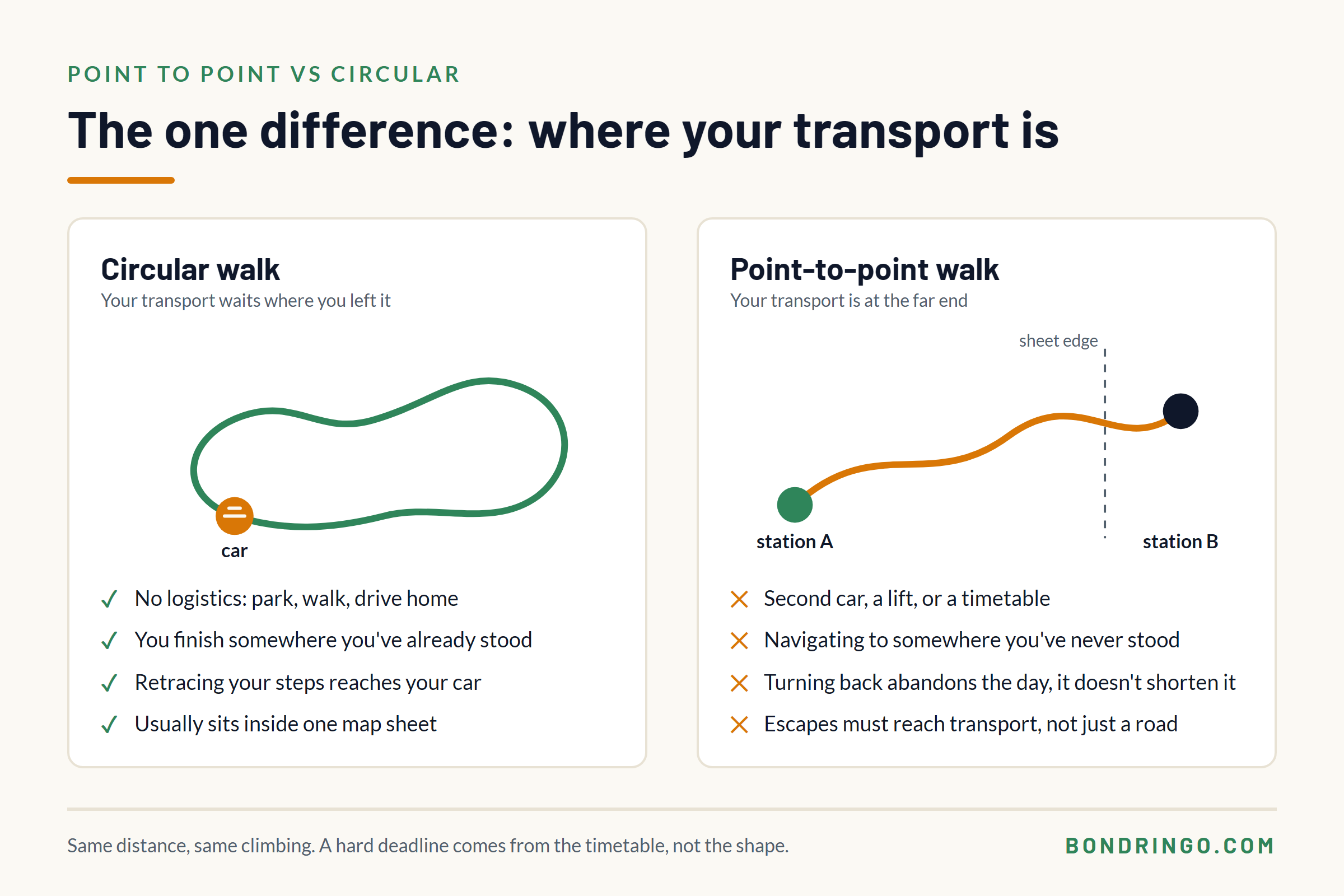
A circular walk starts and finishes in the same place, so whatever you arrived in is waiting where you left it.
A point-to-point walk, or linear walk, finishes somewhere else. Your transport is either at the far end, back at the start, or has to be arranged.
That’s the whole thing. Everything below is a consequence of it, and if a claimed difference doesn’t trace back to that sentence, it’s probably not real.
What a Loop Genuinely Gives You
Three things, and the first one is the one people actually feel.
No logistics. You park, you walk, you drive home. No second car, no lift arranged, no timetable, no working out how to get from the finish back to the start. This is the everyday advantage and it’s the reason most walks in guidebooks are loops.
Your transport is at a place you already know. You’ve stood in that car park. You know what the gate looks like and which way the track bends. Finding your way back to somewhere you’ve physically been is a much easier navigational job than finding somewhere you haven’t.
Retracing your steps takes you somewhere useful. If you’re genuinely unsure where you are, turning round and going back the way you came eventually delivers you to your car. On a linear route it delivers you to a place you deliberately left, which may or may not be any help.
What Doesn’t Actually Change
This is where most advice on the subject falls over, so it’s worth going through carefully.
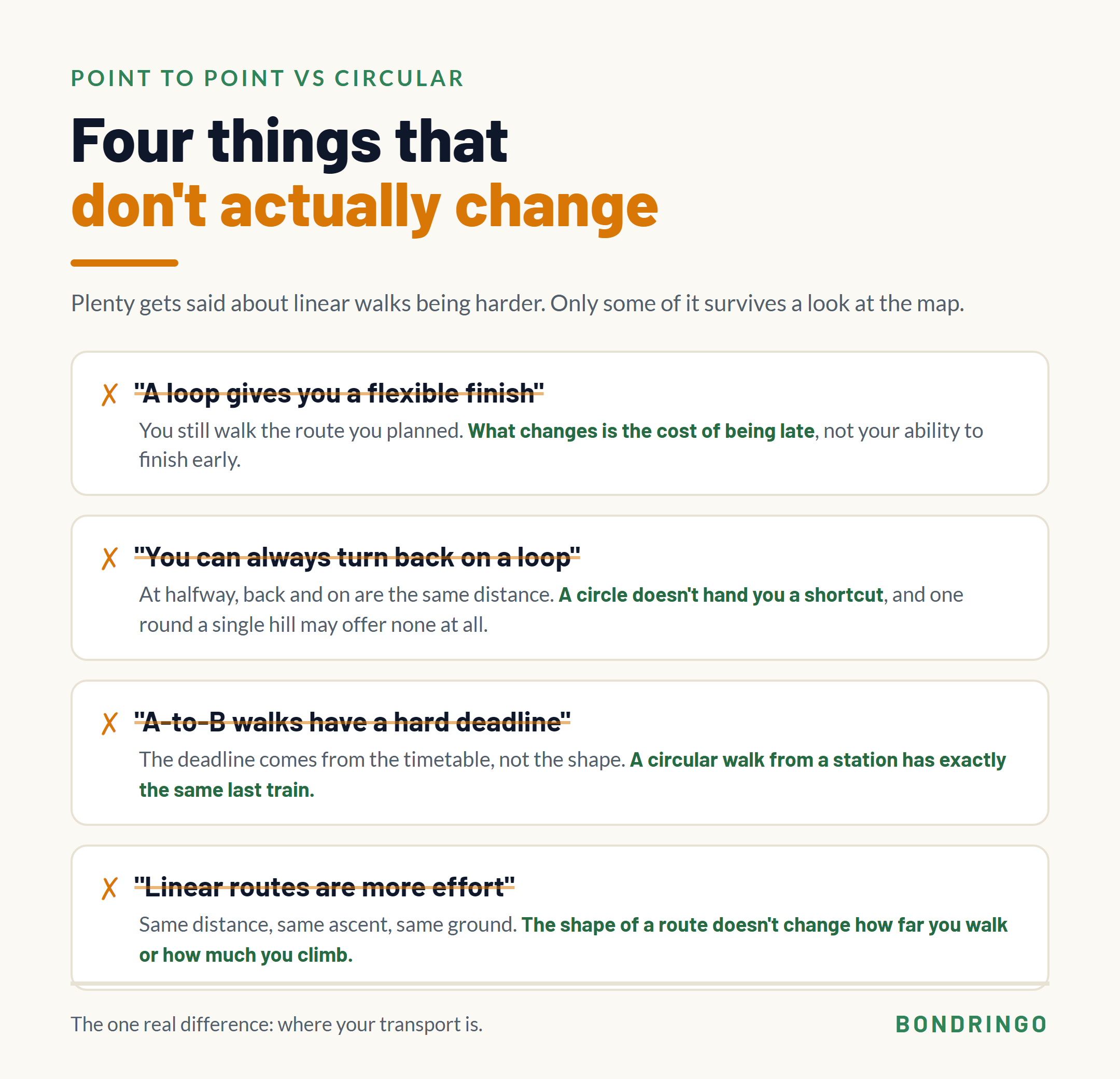
The distance and the climbing. A 20km loop is 20km. If you’ve planned 800 metres of ascent, you’re walking up 800 metres whichever shape the route is. Nothing about a circle makes the day shorter or the legs easier.
Your finish time. I’ve seen it said that a loop gives you a flexible finish. It doesn’t. You still have to walk the route you planned. What changes is the cost of finishing late, not your ability to finish early.
Whether turning back helps. Halfway round a loop, going back is the same distance as going on, by definition. And on a route that circles a mountain there may be no way to cut across at all. A circular shape does not automatically hand you a shortcut, and plenty of loops have no realistic bail-out for hours at a time.
The deadline. This one matters most. A hard finish time comes from public transport, not from route shape. A circular walk that starts and ends at a railway station has exactly the same last-train problem as a linear one. If you drove to a linear walk and left a second car at the finish, you have no deadline at all.
So when people say A-to-B walks have a hard deadline, what they actually mean is that A-to-B walks are usually done by train or bus. That’s a real pattern, but it’s worth knowing which thing is causing what.
The ground itself. A path doesn’t get steeper or rockier because of the shape of the route it’s part of.
Never Feel Lost Again: The Free UK Navigation & Safety Pack
Stop relying solely on a fragile phone battery. Download the exact tools a professional outdoor instructor uses to stay safe in the British hills.

Enter your email below to get instant access to:
- NEW: The Hike Planning & Safety Checklist: A comprehensive pre-walk checklist to ensure you never leave a critical item behind or rely purely on a smartphone.
- The Emergency Protocol Guide: A highly structured, zero panic system detailing exactly what to do if lost on Dartmoor/Scottish hills, including when and how to call Mountain Rescue.
- The OS Map & Navigation Cheat Sheet: A quick reference guide to decoding complex map symbols and plotting grid references when your mind goes blank.
- The Route Card Template: The exact, logic-driven framework I use to plan foolproof expeditions and identify safe escape routes before leaving the house.
- The Timing Crib Card: Never misjudge daylight again. Master the mathematics of measuring pacing distance and timings for steep ground.
What Genuinely Does Get Harder
Strip out everything above and you’re left with these. They’re fewer than you’d think, and they’re real.
1. You’re navigating towards somewhere you’ve never stood
On a loop, your target is a place you’ve already seen. On a linear route, it isn’t. You can’t recognise it, you can only find it.
You’ll often spot the finish once you’re close, especially if it’s a village or a station. But recognition helps you *confirm* you’ve arrived. It can’t help you *get there*.
This is where handrails and attack points earn their keep. A handrail is a long feature you can follow, like a wall, a stream or a forest edge. An attack point is an obvious feature near your target that you aim for first, then navigate the last short leg from.
If handrails and attack points are new to you, our guide to using a map and compass on the hill covers them alongside the rest of the core skills.
2. You can’t shorten the day by turning back
On a loop, if things are going badly, going back the way you came is at worst the same effort as continuing, and it takes you to your car.
On a linear route, your transport is at the far end. Turning back doesn’t shorten the day, it abandons it, and it leaves you at a start point where nothing is waiting unless you planned for that.
The practical consequence is that you commit earlier, and you should decide in advance at what point you’re committed.
3. Your escape routes have to reach transport, not just a road
Every walk should have escape routes. On a loop they can be fairly rough, because you’re heading towards a car anyway.
On a linear route an escape route has to deliver you somewhere you can actually leave from. A track that drops you onto a single-track lane eleven miles from the nearest bus stop is an escape on paper only.
Mark them on the map before you go, and check what’s at the bottom of each one.
4. You’re more likely to run off the edge of the map
Circular walks tend to sit tidily inside one sheet, because they’re often built around a single car park.
Linear routes head in one direction for hours, so they cross sheet edges far more often. There is nothing quite like reaching for the next feature and finding a white margin where the hillside should be.
If your route crosses one, carry both maps, order a custom printed map from Ordnance Survey covering the whole line, or make sure your digital mapping covers it and your phone will last the day. Our guide to OS map numbers shows how to work out which sheets you need.
If You’re Going by Train or Bus
Most linear walks in this country are done by public transport, so this is worth its own section. Note that all of it applies equally to a circular walk from a station.
The last service is a fixed time. Not roughly. Exactly. That turns timing from a loose estimate into the thing the day depends on. Naismith’s Rule, which allows around 5km an hour on the flat plus a minute for every 10 metres of ascent, stops being course theory and becomes the calculation that decides whether you sleep in your own bed.
Set a turnaround time. Decide in advance the time by which you must be at a given point, and what you’ll do if you aren’t. That decision is much easier made at the kitchen table than on a ridge at four o’clock.
Chasing a deadline degrades your decisions. When you’re worried about the time, you’re more likely to take the risky shortcut, press on in worsening weather, or skip the stop where you’d normally check the map properly. The clock doesn’t just cost you time.
There’s an upside worth knowing too. On a station-to-station walk, both ends have transport, so turning back to where you started is often a perfectly good option. That’s a genuine advantage of a train-based linear walk over a linear walk you’ve arranged a lift for.
How to Plan a Point-to-Point Walk
All of this is solvable at the kitchen table. Here’s the order I’d do it in.
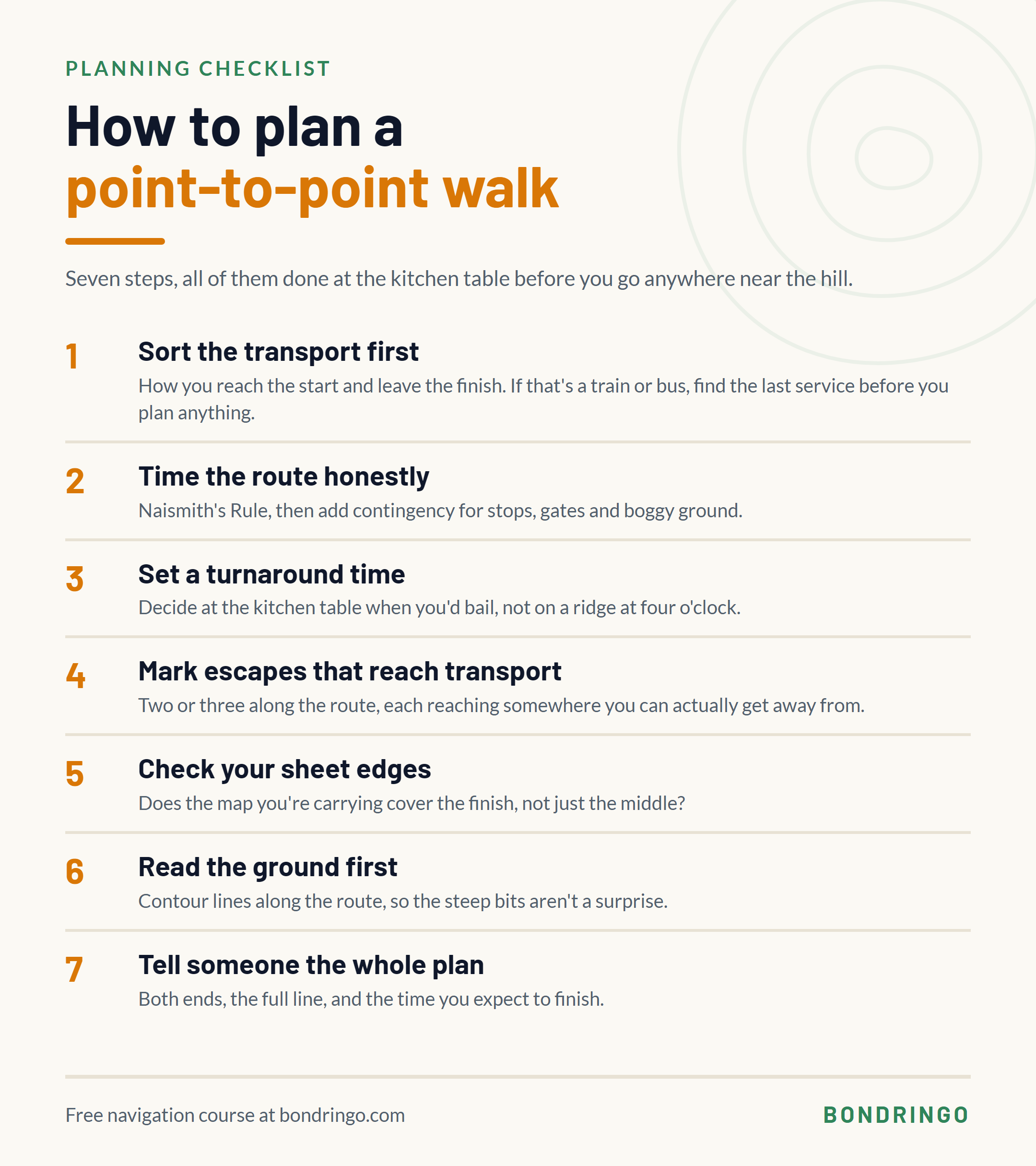
1. Sort the transport first. Not the route. Work out how you’re getting to the start and away from the finish, and if that’s a train or bus, find the last realistic service before you plan anything else.
2. Time the route honestly. Naismith’s Rule, then add contingency for stops, photographs, gates, boggy ground and the fact that nobody walks all day at their best pace.
3. Set a turnaround time. And decide what you’ll do if you hit it.
4. Mark escape routes that reach transport. Two or three, spread along the route, each leading somewhere you can actually get away from.
5. Check your sheet edges. Then check the map you’re carrying covers the finish, not just the interesting bit in the middle.
6. Read the ground before you go. Look at the contour lines along your route so the steep sections aren’t a surprise.
7. Tell someone the whole plan. On a circular walk, “I’m parked at X” locates you. On a linear walk they need both ends, the line between them, and your expected finish time.
So Should You Start With Circular Walks?
Yes, mostly, and for a simpler reason than navigation. Loops are less faff. You can decide on Friday night to walk one on Saturday, which matters far more than most advice admits.
But don’t stay there forever, because linear routes open up a whole category of walking. Traverses, ridges end to end, valley-to-valley crossings, coastal stretches. A lot of the best days in the UK hills don’t come back to a car park, and if you only ever walk loops you’ll never do them.
They’ll also make you a better navigator, for the honest reason set out above rather than the vague one. Navigating towards an unfamiliar target, with real commitment and a finish you have to reach, asks more of you than following a path back to where you parked.
Have a go at this. Take a walk you already know as a loop, and plan the linear version of it on the map at home. Work out how you’d get to each end, what time you’d have to leave, and where you’d bail out if the weather turned. You don’t have to walk it. Planning it will teach you plenty on its own.
What is a point-to-point walk?
A point-to-point walk, also called a linear walk, starts in one place and finishes in another rather than looping back to where you began. The defining consequence is that your transport isn’t waiting at the finish, so you need a second car, a lift, or public transport at both ends.
What is a linear walk?
A linear walk starts in one place and finishes in another, instead of looping back to where you began. It is the same thing as a point-to-point or A-to-B walk. Because you finish somewhere else, the first planning question is how you get back: a second car, a lift, or a bus or train.
Are circular walks easier than linear walks?
Easier to organise, yes, and slightly easier to navigate. A loop returns you to transport at a place you already know, and retracing your steps takes you somewhere useful. But the distance, the climbing and the terrain are whatever you planned them to be. A loop doesn’t make the walking itself easier.
Do linear walks have a hard deadline?
Only if your transport does. The deadline comes from the last train or bus, not from the shape of the route. A circular walk starting from a railway station has exactly the same deadline, and a linear walk with a car left at each end has none at all. It’s worth being clear which one is actually driving your timings.
Can you turn back halfway round a circular walk?
You can, but it rarely helps. At the halfway point, going back is the same distance as going on. Some loops offer a genuine shortcut across the middle and many, particularly those circling a single hill, offer nothing at all. Check for real bail-out options on the map rather than assuming a circular shape provides them.
How do I plan a walk around the last train?
Work backwards from the departure time rather than forwards from your start. Apply Naismith’s Rule to estimate the walking time, allowing around 5km an hour plus a minute for every 10 metres of ascent, then add contingency for breaks and slow ground. Set a turnaround time part-way along so you know when to take an escape route instead of pressing on.
Do I need two maps for a linear walk?
Sometimes. Linear routes cross OS sheet edges far more often than circular ones because they keep heading in one direction. Check your full route against the sheet boundaries before you go. If it crosses one, carry both maps, order a custom printed map covering the whole line, or make sure your digital mapping covers it and your phone has the battery to last.
Build the Skills That Make Either One Easier
Most of what makes a linear walk feel committing is really about confidence. Knowing where you are, trusting your timings, and being able to relocate when you’ve drifted.
Our free Digital Safety Net course walks you through planning a walk properly from home, from setting your phone up before you leave to knowing exactly what to do when something doesn’t go to plan. It’s free and you can work through it at your own pace.
Ask any questions in the comments below.


