

Everyone’s busy this weekend, the forecast is good, and you’re sitting there wondering whether going on your own would be brave or stupid.
You’re probably asking the wrong question. Readiness isn’t a level you arrive at, it’s a match between what you can do and the specific walk in front of you. Almost everybody reading this is ready to walk alone on some hill, and almost nobody is ready for every hill. The useful question is not “am I ready” but “am I ready for this one”.
Below is an honest self-assessment: five things you should be able to do, a straight yes-or-no test, and what to do about the answers you don’t like.
Confidence Is a Bad Guide
The first thing to get out of the way is that how ready you feel is close to useless as a measure.
Feeling confident mostly tracks how familiar something is, not how competent you are at it. People who have walked the same three routes for years often feel very ready, right up until they’re somewhere unfamiliar with the cloud down.
And it runs the other way just as often. Plenty of people who are entirely capable of a solo day out feel like frauds about it, usually because they’ve always walked with someone who did the navigating and they’ve never had to find out what they know.
So park the feeling. Ask instead what you can actually do, and be honest, because the only person you’d be flattering is yourself.
The Real Question: Ready For What?
Here’s the reframe that makes this whole thing manageable.
A waymarked valley path on a clear July morning and a featureless plateau in November cloud are not the same activity. They share a name and almost nothing else.
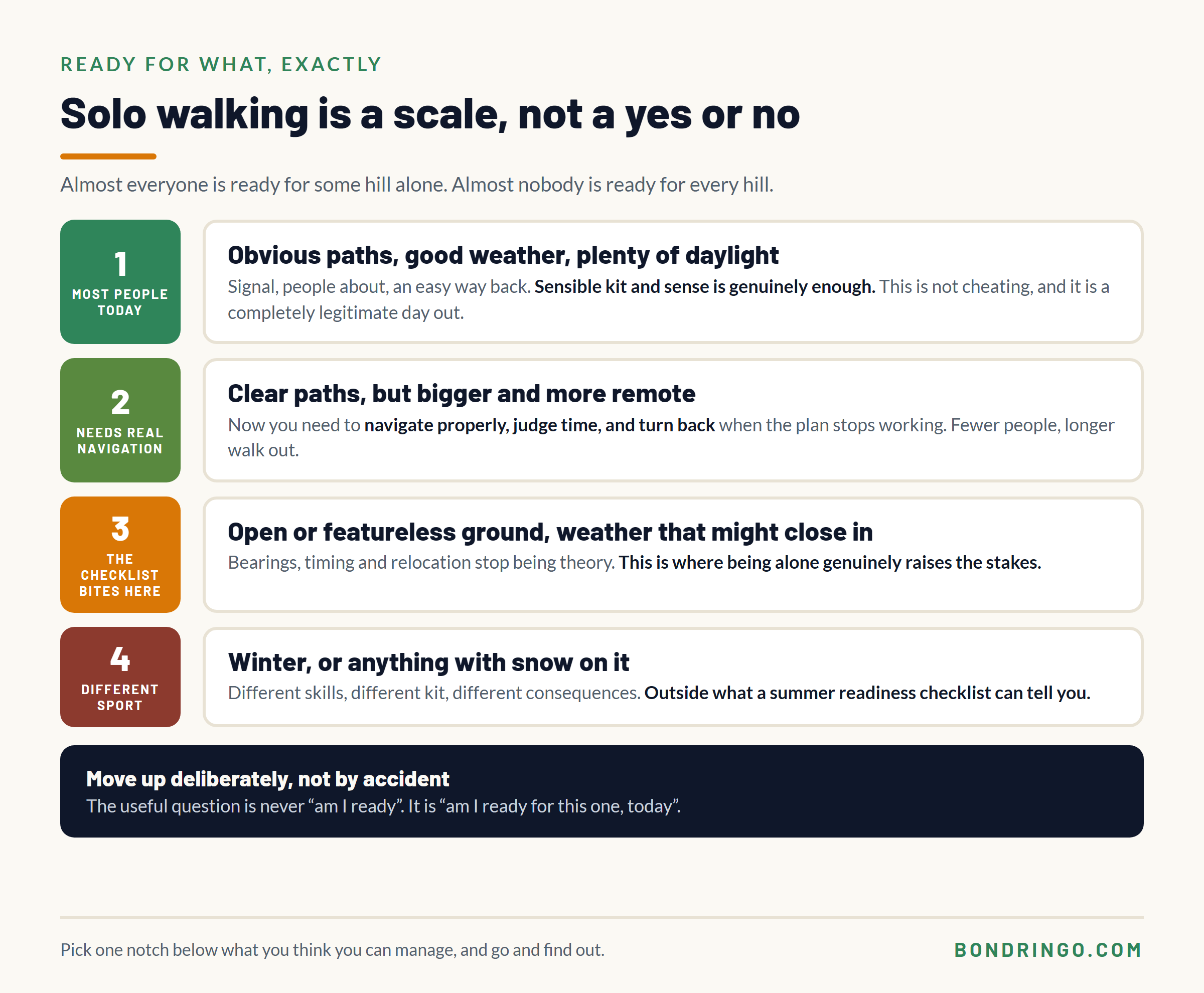
So instead of one big yes or no, you’re placing yourself on a scale.
- Obvious paths, good weather, plenty of daylight, phone signal, people about. Most people with sensible kit and a bit of sense are ready for this alone, and it’s a completely legitimate way to spend a day. It is not cheating.
- Clear paths but bigger and more remote. Now you need to be able to navigate properly, judge time and turn back when the plan stops working.
- Open, featureless or high ground, or anything where the weather might close in. This is where solo genuinely raises the stakes, and where the checklist below actually bites.
- Winter, or anything with snow on it. Different sport, different skills, and outside what this article covers.
Nearly everyone can say yes to the first rung today. The work is moving up the scale deliberately rather than by accident.
Five Things to Be Able to Do
These are the ones that matter when there’s nobody else there. Not because solo walking is dangerous, but because every one of these is a job somebody else might otherwise have quietly done for you.
1. Say exactly where you are, without your phone. Not “near a big rock”. A grid reference off a paper map, or at minimum a confident description of your position relative to features you can name. If your phone is your only answer to this question, your phone is a single point of failure.
2. Get yourself off the hill when you can’t see. Cloud comes down more often than people expect. Can you take a bearing, follow it, and walk off a hill you can’t see the bottom of? If not, that’s the single biggest gap on this list.
3. Notice you’re off route within minutes, not hours. This is really a habit rather than a skill. It comes from checking the map regularly rather than only when something already feels wrong.
4. Turn round when the plan stops working. Easy to say. Genuinely hard to do alone, because there’s nobody to agree with you, and nobody to blame. Working out how long a walk will actually take beforehand is what turns this from a vague intention into a decision you can make on the clock.
5. Call for help properly. Know that it’s 999 and then Police, then Mountain Rescue. Have Text 999 registered before you need it. Know that asking for help early is the sensible move, not an embarrassment.
If you can do those five, you are ready for a great deal more than you think.
Never Feel Lost Again: The Free UK Navigation & Safety Pack
Stop relying solely on a fragile phone battery. Download the exact tools a professional outdoor instructor uses to stay safe in the British hills.

Enter your email below to get instant access to:
- NEW: The Hike Planning & Safety Checklist: A comprehensive pre-walk checklist to ensure you never leave a critical item behind or rely purely on a smartphone.
- The Emergency Protocol Guide: A highly structured, zero panic system detailing exactly what to do if lost on Dartmoor/Scottish hills, including when and how to call Mountain Rescue.
- The OS Map & Navigation Cheat Sheet: A quick reference guide to decoding complex map symbols and plotting grid references when your mind goes blank.
- The Route Card Template: The exact, logic-driven framework I use to plan foolproof expeditions and identify safe escape routes before leaving the house.
- The Timing Crib Card: Never misjudge daylight again. Master the mathematics of measuring pacing distance and timings for steep ground.
The Honest Self-Test
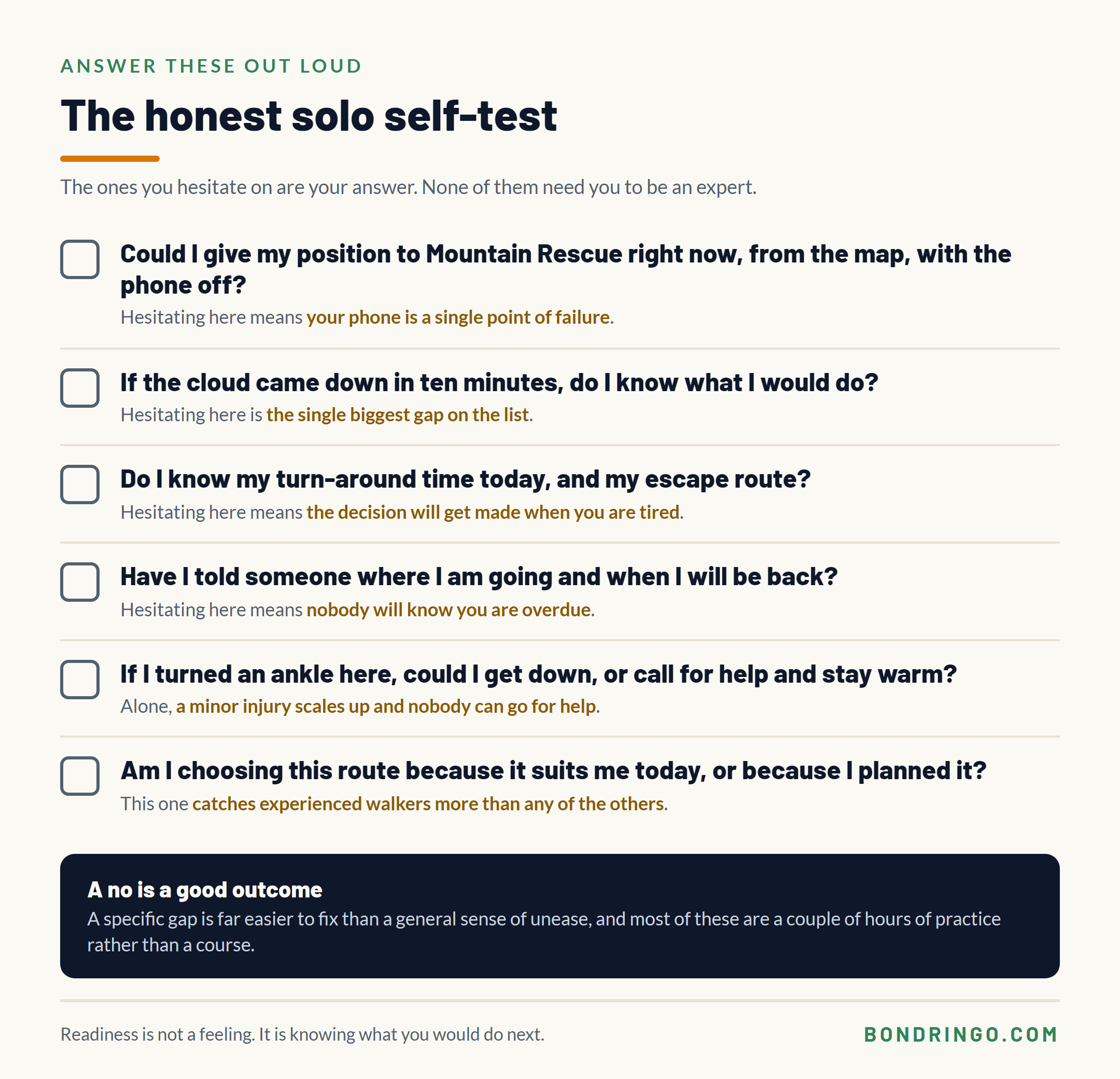
Answer these out loud. The ones you hesitate on are your answer.
- Could I give my position to Mountain Rescue right now, from the map, with the phone switched off?
- If the cloud came down in the next ten minutes, do I know what I’d do?
- Do I know what time I need to turn around today, and what my escape route is?
- Have I told someone where I’m going and when I’ll be back?
- If I turned an ankle here, could I get myself down, and if not, could I call for help and stay warm until it arrived?
- Am I choosing this route because it suits me today, or because I’d planned it and don’t want to waste the drive?
That last one catches more experienced walkers than any of the others.
None of these require you to be an expert. They require you to have thought about it before you’re standing in the weather.
If you’d like something more objective than your own judgement, our free Navigation Test is twenty-three questions and takes about eight minutes. There’s no signup, and every answer comes with an explanation, so the ones you get wrong are the useful ones.
If you want the shortest possible version of this, AdventureSmart, the UK safety campaign run with the rescue services, boils it down to three questions before you go out: do I have the knowledge and skills for the day, do I know what the weather will do, and have I got the right kit. Three out of three and you’re good. Anything less and you know where the work is.
What Actually Changes When You’re Alone
Worth being clear-eyed about this, because it’s not the things people expect.
There’s no second opinion. Groups catch each other’s mistakes. Alone, a wrong turn is only caught by you, and if you’ve talked yourself into it once you’ll happily do it again.
Nobody can go for help. In a group, one person stays and one goes. Alone, if you can’t move, you are relying entirely on being able to raise the alarm yourself. That’s why the phone, the battery and the registered text matter more than they do in company.
Small problems scale up. A twisted ankle three miles out is an inconvenience with friends and a serious situation alone. Nothing about the injury changed.
Nobody notices you’re overdue unless you told them you’d be back. Which is why leaving word isn’t box-ticking, it’s the entire safety net.
You carry everything yourself. In a group the shelter, the first aid kit and the spare food get spread around. Alone, all of it is on your back or it isn’t there.
You get all the decisions. That’s the joy of it, honestly. It’s also tiring in a way people don’t anticipate on a long day.
Counting lemons
Here’s a way of thinking about it that’s worth more than any checklist.
Days rarely go wrong because of one big thing. They go wrong because small things stack up. No phone signal. Cloud lower than forecast. A path that isn’t where you expected. Feeling more tired than you should. Boots rubbing.
Instructors sometimes call these lemons. Any one of them is fine, and you’d walk on without a second thought. Three or four together is the hill telling you something, and alone you don’t have anyone else to notice the pattern.
So count them. When you get to three, that’s not bad luck, that’s your cue to take the easy option while you still have one.
What doesn’t change is the hill. Solo walking is a normal, popular and reasonable thing to do. It just moves several jobs onto you that you might not have realised were being done.
If You Answered No to Some of Those
Good. That’s the point of an honest assessment, and it’s a much better outcome than a vague sense of unease.
Nothing here is a barrier, and none of it takes long.
If you can’t place yourself on a map without a phone, that’s a couple of hours of practice, not a course. Do it on ground you know, where being wrong costs nothing. Our guide to practising navigation without getting lost is built entirely around exactly that.
If poor visibility is the gap, don’t go looking for it. Learn bearings properly on a clear day first, on ground where you can see whether it worked.
If turning back is the hard part, set a turn-around time before you leave and treat it as a rule rather than a suggestion. It’s much easier to obey a decision made at the kitchen table.
If you’re not sure you’d cope alone with something going wrong, walk somewhere with an easy bail-out and phone signal a few times first. Build the evidence.
And the most useful step of all is the boring one. Pick a walk one notch below what you think you can manage, and go and do it on your own. Not to prove anything. To find out what you actually reach for, in a place where the answer doesn’t matter.
The Non-Negotiables
Whatever rung you’re on, these four don’t scale with difficulty. Do them every time you go out alone.
1. Tell someone the route and your expected return time. A photo of your map with a rough line on it and a time is enough. This is the single most valuable thing on the list.
2. Carry a paper map and compass, and be able to use them. The phone is the convenience. The map is the backup that doesn’t run out.
3. Take a headtorch, spare warm layer and something to eat, even on a short day. Our kit list for the hill has the full picture.
4. Have a turn-around time and an escape route, decided before you set off.
That’s it. Not a big ask, and it converts most of the risk of solo walking into a plan.
Two small extras worth knowing about.
Say hello to people. It sounds like manners, and it is, but it’s also quietly useful. Anyone you exchange a word with has now registered a walker in a green jacket heading up towards the col at about eleven. If you’re ever reported overdue, that’s the kind of detail that shortens a search enormously.
If you walk alone regularly in remote places, a satellite messenger is worth a look. Phone signal disappears behind hills, and a dedicated device lets you send an “I’m fine” check-in or an SOS without it. Not necessary for a day on a popular hill, genuinely useful further out.
What Being Ready Actually Feels Like
Slightly anticlimactic, is the honest answer.
It doesn’t feel like confidence. It feels like knowing what you’d do next. You look at the cloud coming in and instead of a flutter of dread you get a small, calm list: check position, check time, take the bearing, or drop into the valley.
That shift usually arrives quietly, a couple of outings after you were convinced you weren’t improving. And when it does, going out alone stops feeling like a test and starts feeling like the best day of the week.
The Short Version
Don’t ask whether you’re ready to walk alone. Ask whether you’re ready for this particular walk, on this particular day.
Be able to fix your position without a phone, get off a hill you can’t see, notice you’re off route, turn back when you should, and call for help properly. Tell someone where you’re going. Then pick something one notch easier than you think you need, and go.
Frequently Asked Questions
Is it safe to go hill walking alone?
Yes, for a very large number of people and routes, and it’s a normal thing to do. What changes when you’re alone is not the hill but the jobs. There’s no second opinion on decisions, nobody to go for help, and a minor injury has bigger consequences. That’s manageable with a paper map you can use, a way of calling for help, and someone at home who knows your route and return time.
How do I know if I’m experienced enough to hike alone?
Test it against specific abilities rather than a feeling. Can you fix your position from a paper map without your phone? Could you navigate off a hill in cloud? Would you notice within minutes if you left your route? Do you set a turn-around time and stick to it? Do you know how to call for help? If you can do those, you’re ready for a lot more than you think, and if you can’t, each one is a short bit of practice rather than a barrier.
What is the biggest risk of walking alone?
Not being able to raise the alarm. In a group, if someone is hurt, another person can go for help. Alone, that route doesn’t exist, so everything depends on being able to contact somebody yourself and stay warm while you wait. That’s why a charged phone, a registered Text 999, and telling someone your route and return time matter far more when you’re on your own.
Should I tell someone where I’m going?
Always, and it’s the single most valuable thing you can do. Send a photo of your map with your route on it and the time you expect to be back. Without it, nobody knows you’re overdue, and being reported overdue is often what starts a rescue before things get serious. It takes about thirty seconds.
What should I do if I get lost while walking alone?
Stop moving. Most people make it worse in the first ten minutes by walking on hopefully. Work out where you last knew your position for certain, look at what’s around you, and try to match it to the map. If you genuinely can’t work it out and can’t safely get down, call for help early rather than late. There’s a fuller walkthrough in what to do if you get lost hiking.
Is walking alone in poor visibility a bad idea?
For most people starting out, yes. Poor visibility removes the landmarks you have been unconsciously relying on and leaves you with map, compass and timing alone. Learn those on clear days first, on ground where you can immediately see whether you got it right. Then meet bad visibility on familiar ground before you meet it anywhere new.
Build the Bit That’s Missing
If this has left you with one specific gap rather than a general worry, that’s a good outcome. It’s a much easier thing to fix.
The free Digital Safety Net course is sixteen lessons on making your phone genuinely reliable in the hills: fixing your position, getting a grid reference, and setting things up so a flat battery is never the reason you’re stuck. It’s the fastest way to close the most common gap on the list above, and it costs nothing.
So, which of the five could you not do today? Ask any questions in the comments below.


