
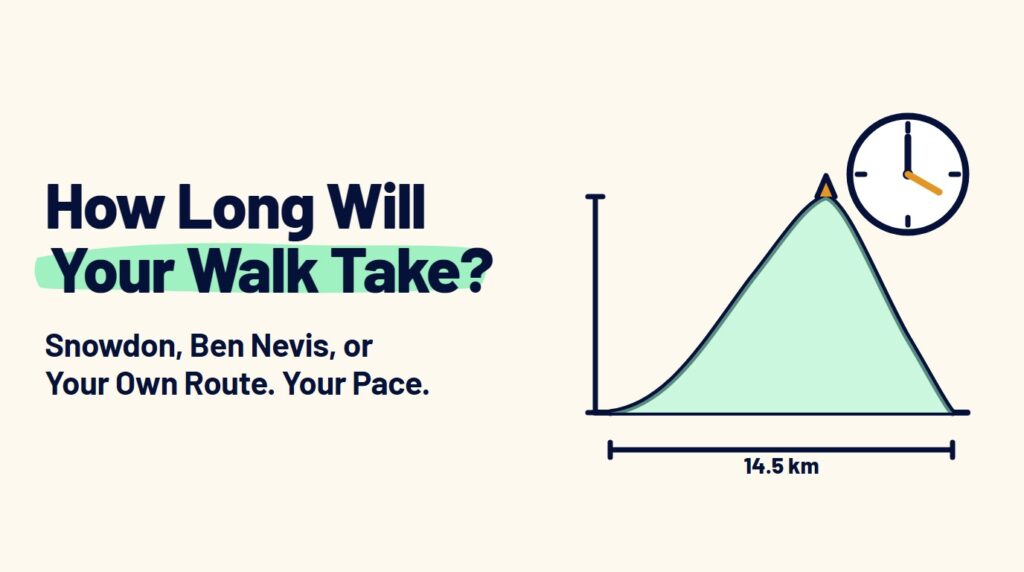
Tap a mountain or type your own distance and ascent, and the calculator gives you a walking time using Naismith’s rule with the corrections that make it honest: the slower pace most of us actually walk at, the time steep descents cost, and a quarter on top for stops. Give it the time you need to be back and it tells you when to leave, and when to turn round if you are behind.
Every page that answers “how long does it take to climb Snowdon” gives you a range. This gives you your number, for your pace and your day, and you can change any figure in it.
Free tool · Walk time calculator
How long will your walk take?
Tap a mountain or type your own distance and ascent. The time uses Naismith’s rule with the corrections that make it honest, and if you give it a deadline it tells you when to leave.
Naismith’s rule (1892): one hour per 5 km plus one hour per 600 m of ascent. Langmuir (1984): a group walks at 4 km/h plus one hour per 450 m; gentle descent saves 10 minutes per 300 m, steep descent costs it. The quarter for stops, the pack and darkness figures are working rules of thumb, not published formulas. Preset distances are the national park, National Trust or OS figures for the named routes; where no official ascent is published it is worked out from the start and summit heights, and each preset says where its figures come from. Your own track will differ a little. None of this includes bad ground, river crossings or navigation stops in poor visibility: add them yourself, and time yourself on a known route to find your own factor.
How long does it take to climb Snowdon?
Between about 4 and a half and 7 and a half hours there and back, depending on the path and on you. On the Llanberis Path, 14.5 km with 975 m of ascent, a fit walker who never stops is looking at about 4 h 30 on Naismith’s rule alone, and a normal group with lunch and photographs at about 6 h 30, which is why Eryri National Park tells you to allow 7 hours. The Pyg Track is shorter at 11 km but steeper, so it comes out about the same: 3 h 45 at the fastest, 6 h 30 for most. The Watkin Path has the most climbing, 1,015 m, and runs to 7 h 30 for a group.
The six paths are all in the calculator with the National Park’s own distances and ascents. Load the Llanberis Path, the Pyg Track, the Miners’ Track, the Watkin Path, the Rhyd Ddu Path or the Snowdon Ranger Path, then set who is walking and the time you need to be down.
How long does it take to climb Ben Nevis?
About 5 and a half hours at the very fastest, and nearer 8 for most people. The Mountain Track from the Glen Nevis visitor centre is around 16.5 km there and back with roughly 1,325 m of climbing, because you start almost at sea level and finish on the highest ground in Britain at 1,345 m. Naismith alone gives 5 h 30; a group with stops gives just under 8 hours, which sits inside the 6 to 9 hours the Nevis Landscape Partnership and OS quote. Load Ben Nevis and put your train or your sunset in the deadline field, because the summit plateau is not somewhere to be finishing in the dark.
How long does it take to climb Pen y Fan?
About 2 to 3 hours for the circular from Pont ar Daf. The National Trust’s Pen y Fan and Corn Du circular is 6.4 km with about 450 m of climbing from the car park on the A470. Naismith gives 2 hours, a group with stops just under 3, which matches the 2 h 30 to 3 h 30 the Trust quotes. It is the shortest walk on this page and the one most often underestimated in winter, when the top is a different place from the car park. Load Pen y Fan.
How long does it take to climb Scafell Pike?
About 3 and a half to 6 hours from Wasdale Head. The direct route via Brown Tongue and Hollow Stones is around 9.4 km with 900 m of ascent, and it is steep and rough enough coming down that the calculator adds time for the descent rather than taking it off. Naismith alone says 3 h 25; most people with stops are nearer 6 hours, which is why the National Trust says allow 5. Load Scafell Pike. The route figures here are from a published walk description rather than an official source, so treat them as close rather than exact.
How long does it take to climb Helvellyn?
About 4 and a half to 7 and a half hours by Striding Edge, or 2 and a half to under 5 from Swirls. The classic round from Glenridding, up Striding Edge and down Swirral Edge, is about 14 km with 900 m of ascent, and the two edges are slow ground whatever your fitness, so budget the top of that range. The direct route from the Swirls car park on Thirlmere is 7.2 km with about 730 m of climbing and comes out at 2 h 40 to 4 h 45. Load the Striding Edge round or the Swirls route. No national park or National Trust figures exist for Helvellyn; these come from published walk descriptions and the start and summit heights.
How long does it take to climb Kinder Scout?
About 4 to 6 hours for the Edale circular. The loop up Grindsbrook and down Jacob’s Ladder, along the southern edge of the plateau, is about 14.5 km with just under 600 m of ascent in total, most of it in two short steep pulls. Naismith gives 3 h 55; a group with stops just under 6, which brackets the 4 h 30 to 5 h 30 the National Trust quotes for its slightly shorter version. Load Kinder Scout. Kinder is a plateau, so in cloud the time you lose is to navigation, not to climbing; that is not in any formula.
How long does it take to walk 5 km, 10 km, 5 miles or 10 miles?
On flat ground with no climbing, the calculator’s two paces give these, and the third column adds the quarter for stops that a day out actually contains.
| Distance | Fit and steady (5 km/h) | Most of us (4 km/h) | Most of us, with stops |
|---|---|---|---|
| 5 km | 1 h | 1 h 15 | 1 h 34 |
| 5 miles (8 km) | 1 h 36 | 2 h | 2 h 30 |
| 10 km | 2 h | 2 h 30 | 3 h 08 |
| 8 miles (13 km) | 2 h 36 | 3 h 15 | 4 h 04 |
| 10 miles (16 km) | 3 h 13 | 4 h 02 | 5 h 02 |
| 20 km | 4 h | 5 h | 6 h 15 |
Add the ascent and the numbers move a long way. Ten kilometres with 600 m of climbing is not a 2 hour walk, it is a 3 hour one before anyone has stopped. That is the single most useful thing the rule does: it stops you judging a walk by its length.
How the walk time calculator works
Naismith’s rule, from 1892, is one hour for every 5 km plus one hour for every 600 m of ascent. It describes a fit walker in good conditions who never stops, so it is the fastest your day could reasonably go, not the time it will take. The calculator shows that figure underneath every answer so you can see the gap.
Langmuir’s corrections, from 1984, do two things. For a group, or for most of us on an ordinary day, use 4 km/h and one hour per 450 m instead, which is the default here. For descent, gentle ground of 5 to 12 degrees saves 10 minutes per 300 m, but steep ground over 12 degrees costs 10 minutes per 300 m, which is the bit people get wrong. The presets set the descent ground for you; change it if you know the route.
Stops, packs and darkness are working figures rather than published formulas, and the tool says so beside each one: a quarter on top for lunch and faff, about 1 km/h off the flat speed for a heavy multi-day pack, and half pace for any kilometres walked in the dark. The full reasoning, with the worked examples and the fitness corrections, is in Naismith’s rule: how long will your walk actually take?
Your own factor beats all of it. Time yourself on a route you know, stops included, and divide by what Naismith said. If the rule gave 4 hours and you took 5, your factor is 1.25. Put it in the box and every answer on this page becomes yours rather than a Victorian mountaineer’s.
Working backwards from the last train
Most of the time the question is not “how long will this take” but “can I get back in time”. Put the time you need to be back in the deadline field, pick a buffer, and the calculator gives you the time to leave. Add the time you are actually setting off and it gives you a turn-around time at the halfway point: a time at which, if you are not at a feature you will recognise, you know you are behind while you still have options. If the leave-by time is unrealistically early, the route does not fit today, and knowing that at the kitchen table is the whole point.
That matters most on public transport. If you walk the UK hills without a car, use the second-to-last service, not the last, and if it goes wrong anyway, what to do if you miss the last train off the hill covers the rest.
Plan the whole day, not just the time
A time is one line on a route card. The rest is the escape routes, the bearings for the bits that matter in cloud, and the things you check before you leave. The free Digital Safety Net course covers how to plan a walk you can actually finish, how to set your phone up so it is reliable on a hill, and what to do when the day goes wrong. It is free, and the route card template in its resource pack has a space for exactly the number this page just gave you.
Walk time calculator: common questions
Can you walk up Snowdon in 4 hours?
A fit walker on the Pyg or Miners’ Track, moving steadily and not stopping, can be up and down in about 4 hours by Naismith’s rule, and some do it faster. For most people, with photographs and lunch, 6 to 7 hours is realistic on any path. Load the path in the calculator, set who is walking, and read your own number rather than someone else’s.
How long does it take a beginner to climb Snowdon?
Plan on 6 to 7 hours for the Llanberis Path, and leave the steeper Pyg, Miners’ and Watkin paths until you have done it once. The calculator’s default pace, 4 km/h plus one hour per 450 m of ascent, is the right one for a first ascent. Add your deadline and it tells you when to set off; on Snowdon that is usually earlier than people think.
Can you climb Ben Nevis in 4 hours?
Up and down the Mountain Track in 4 hours needs a fit, fast walker who does not stop: Naismith’s rule alone gives about 5 and a half hours for the 16.5 km and 1,325 m of climbing, and the Three Peaks pace is 5 hours or under. Most walkers take 7 to 9 hours. Use the calculator with the fit-and-steady setting and no stops to see the fastest honest figure.
How accurate is Naismith’s rule?
It is accurate for the walker it describes: fit, steady, not stopping, on easy ground. For everyone else it is optimistic, often by an hour or two on a mountain day. That is why the calculator defaults to Langmuir’s slower group pace, adds the descent correction and a quarter for stops, and lets you enter your own factor from a walk you have timed.
How far can I walk in 3 hours?
On the flat, about 15 km at a fit walker’s 5 km/h, or 12 km at the 4 km/h most of us manage with a pack. Every 100 m of ascent costs roughly 10 to 13 minutes on top, so three hours with 600 m of climbing is nearer 8 to 10 km. Type a distance into the calculator and adjust until the time reads 3 hours.
Does going downhill save time?
Only on gentle ground. Langmuir’s correction takes 10 minutes off per 300 m of descent on slopes of 5 to 12 degrees, but adds 10 minutes per 300 m on anything steeper, because picking your way down loose steep ground on tired legs is slow. The calculator has a setting for the descent ground, and the mountain presets choose it for you.