
Most gift guides for walkers are lists of jackets, boots and gadgets. Lovely, but hard to get right for someone else, and not what makes the difference on a hill.
So here’s the short answer. The best Christmas gifts for walkers are the small bits of kit that go in the rucksack every time and make a bad day better: a proper map of their local area, a baseplate compass, a head torch, a survival bag, blister tape. Most of them cost under £40. The present that lasts longest is the skill to use them, and our own online navigation courses start at £27, paid once. And skip anything that has to fit.
Below we’ve grouped the gifts by budget, with why each one earns its place, plus what to skip and the one present that costs nothing.
What makes a good gift for a walker?
Before the list, four quick tests. A good walking gift passes most of them.
- It gets carried every time. Kit that lives in the rucksack gets used. Kit that’s only for “proper” days stays in the cupboard.
- It fixes a real problem on the hill. Cold, dark, sore feet, a dead phone, not knowing where you are. Those are the things that turn a good day into a long one.
- It suits the walking they do now. Crampons are no use to someone who walks lowland footpaths. A map of their local hills is.
- You can’t get it wrong. Boots and jackets have to fit, so leave those to the walker, or give a voucher.
The prices below are typical UK prices in November 2026. Black Friday will move some of them, so treat them as a guide to the budget, not a quote.
Stocking fillers for walkers (under £10)
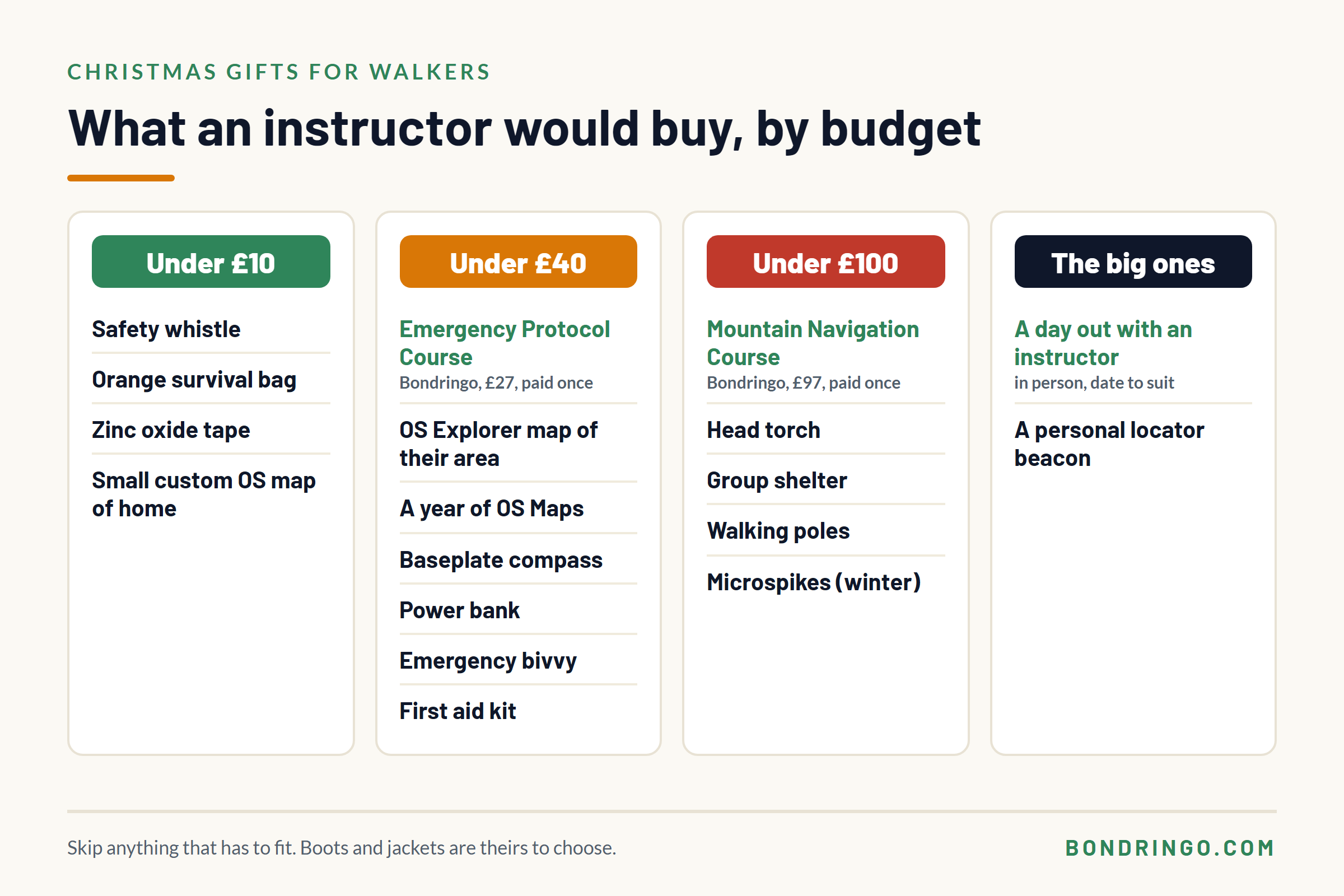
- A safety whistle (a few pounds). It’s the most reliable bit of safety kit in the rucksack. There’s no battery to die, and it carries in wind that would swallow a shout. The distress signal is six blasts spread across a minute, then a minute’s silence, then repeat.
- An orange survival bag (about £6). A big, tough plastic bag you climb into to stay dry and out of the wind while you wait for help. It weighs next to nothing and lives in the bottom of the rucksack. We compare the options in how to choose a bivvy bag.
- A roll of zinc oxide tape (a few pounds). The stiff, sticky strapping tape you put on a hot spot before it becomes a blister. Our guide to blister tape explains which tape does which job.
- A small custom OS map of home (from about £8). Ordnance Survey’s Custom Made maps are centred on a place you choose, like their house or a favourite hill, and come with a month of the OS Maps app.
Gifts for walkers under £40
- Our Emergency Protocol Course (£27, paid once). Twenty-six written lessons on what to do when a walk goes wrong: the kit, everyday first aid, what to do when it’s serious, the hazards on the hill and how to get help. They keep it for life, and £3 from every course goes to mountain rescue services across the UK. It’s the gift for someone whose worry is “what if something happens?” See what’s in it.
- The OS Explorer map for their area (£12.99, or £16.99 for the weatherproof Active version). Every Explorer comes with a code for a digital copy in the OS Maps app, so they get the paper map for the rucksack and the same map on their phone. Not sure which sheet? See which OS map do I need.
- A year of OS Maps Premium (normally £35.99). Ordnance Survey sells it as a gift card, which was reduced when we checked in November. It gives them the Explorer and Landranger maps for the whole of Great Britain, downloadable for offline use, and the gift card doesn’t renew automatically.
- A baseplate compass (about £24 to £40). A clear plastic base, a rotating housing and a straight edge, ideally with romer scales for 1:25,000 and 1:50,000 printed on it. It’ll last for years. More in do you actually need a compass.
- A power bank (about £20 to £40). Around 10,000 mAh is the sweet spot for a day or a weekend. Our guide to making your phone battery last all day explains why it matters, and how to use one in the cold.
- An emergency bivvy bag (about £20). A step up from the plastic survival bag, at around three times the price.
- A basic first aid kit (from about £20). A small personal kit for blisters, cuts and sprains. Our kit list covers what else should be in the rucksack.
Never Feel Lost Again: The Free UK Navigation & Safety Pack
Stop relying solely on a fragile phone battery. Download the exact tools a professional outdoor instructor uses to stay safe in the British hills.

Enter your email below to get instant access to:
- NEW: The Hike Planning & Safety Checklist: A comprehensive pre-walk checklist to ensure you never leave a critical item behind or rely purely on a smartphone.
- The Emergency Protocol Guide: A highly structured, zero panic system detailing exactly what to do if lost on Dartmoor/Scottish hills, including when and how to call Mountain Rescue.
- The OS Map & Navigation Cheat Sheet: A quick reference guide to decoding complex map symbols and plotting grid references when your mind goes blank.
- The Route Card Template: The exact, logic-driven framework I use to plan foolproof expeditions and identify safe escape routes before leaving the house.
- The Timing Crib Card: Never misjudge daylight again. Master the mathematics of measuring pacing distance and timings for steep ground.
Gifts for walkers under £100
- Our Mountain Navigation Course (£97, paid once). The whole of map and compass navigation in a clear order, from reading the map to planning their own route and finding themselves again when they’re unsure. It includes the Emergency Protocol Course and our free course, they keep it for life, and £10 from every course goes to mountain rescue services across the UK. Compared with a two-day course in person, there’s no travel, no fixed dates, and they can revisit it before every walk. See what’s in it.
- A head torch (about £30 to £60). Short winter days catch people out, and a head torch is the difference between a slow walk out and a phone call. Any reliable one they’ll actually carry is the right one. We explain why in the clocks go back.
- A group shelter (about £40 for two people, £55 to £75 for four). A lightweight fabric shelter you pull over your heads and sit in, out of the wind. It turns a cold wait for help, or just a wet lunch stop, into a manageable one.
- Walking poles (about £35 to £90 a pair). Good for knees on the way down and for balance on rough ground. See should I use walking poles.
- Microspikes (about £40 to £70). Small chains and spikes that stretch over a walking boot for icy paths and packed snow. They’re for winter walkers on paths, not for steep snow, which needs crampons and the training to use them.
The big presents
- A day out with an instructor. The gift that makes everything above useful. A one-day navigation course in person is typically around £90 to £110, and a two-day course about £150, more at the national centres, plus travel and somewhere to stay. We run in-person days too, from navigation training to a first proper mountain, and the date can be a rough idea. Our guide to choosing a map reading course compares a day out with an instructor and learning online.
- A personal locator beacon (around £300). A PLB sends an SOS by satellite with no mobile signal needed, and there’s no subscription. Registering it with the UK Beacon Registry is free and takes about 15 minutes. It’s a big present, but it’s a safety net almost anywhere they walk.
How to give one of our courses as a present
Buying a course at the checkout starts it straight away, in the buyer’s name. To give one as a present instead, get in touch with their name, their email address and the day you’d like it to start, and we’ll set it up as a gift so it arrives on the day, not before.
What not to buy a walker
A few things look like great presents and often aren’t.
- Boots and waterproof jackets. They have to fit, and the person wearing them needs to choose them. A voucher for an outdoor shop does the job better.
- A keyring compass. It looks the part, but it can’t take a bearing from the map. If you’re buying a compass, buy a proper baseplate one.
- Gadgets that replace a skill. A GPS watch is a fine thing, but for someone new to the hills a map, a compass and the confidence to use them will do more. More in is your phone enough to navigate.
- Winter kit for a summer walker. Ice axes and crampons need training to use. If they’re heading into winter hills, a winter skills course comes first, which we cover in do you need a winter skills course.
The gift that costs nothing
Here’s one you can give tonight. Sit down with the walker in your life and set their phone up for the hills.
Help them register for emergency texts: text the word “register” to 999 and follow the replies. It takes a couple of minutes, and it means a text can reach the emergency services when there isn’t enough signal for a call. Our guide to registering for Text 999 walks through it.
Then download the map for the area they walk in most, and check it still works with the phone in aeroplane mode. If they use a walking app, our guide to the best walking app in the UK will help them pick one.
Frequently Asked Questions
What do you buy someone who loves walking?
Small kit that goes in the rucksack every time and makes a bad day better: the OS Explorer map for their area, a baseplate compass, a head torch, a survival bag or some blister tape. For a bigger present, a navigation course or a personal locator beacon. Avoid boots and jackets unless they choose them, because they have to fit.
What are good stocking fillers for walkers?
A safety whistle, an orange survival bag, a roll of zinc oxide tape for blisters, or a small custom OS map centred on their home. All cost under £10 and all earn their place in the rucksack.
What is a good gift for a beginner hill walker?
The OS Explorer map of the area they walk in, a baseplate compass and a head torch, ideally with a navigation course so they know how to use them. Our Mountain Navigation Course (£97, paid once) is built for exactly that. Beginners get more from the basics done well than from expensive kit.
Is a compass a good present for a walker?
Yes, if it’s a baseplate compass with a clear base, a rotating housing and romer scales, which costs about £24 to £40. Avoid keyring and novelty compasses, which can’t take a bearing from a map.
Can you give an online navigation course as a present?
Yes. Our Emergency Protocol Course (£27) and Mountain Navigation Course (£97) are both paid once with lifetime access, so they make a present that lasts. To give one as a gift, get in touch with their name, email and the day you’d like it to start, and we’ll set it up so it arrives on the day.
Is a personal locator beacon a good gift?
For someone who walks in remote hills, often alone, yes. A PLB sends an SOS by satellite without mobile signal, there’s no subscription, and registering it with the UK Beacon Registry is free. It costs around £300.
Wrap up the skills, not just the kit
Kit helps, but it’s the person carrying it who gets them home. That’s why the best present on this list is a course, whether it’s a day out with an instructor or our Mountain Navigation Course, which they’ll keep for life.
And if money’s tight this year, the best present might be a link. Our free Digital Safety Net course sets their phone up as a reliable navigation tool in 16 short lessons, and it costs nothing at all.
Which gift would you add? Ask any questions in the comments below.


