

You’ve got an afternoon, not a weekend. The forecast is decent, and every route guide you open seems to assume you left the house at seven.
Half a day is a proper hill walk, not a consolation prize, and the trick is choosing a small route rather than shrinking a big one. Roughly speaking, three to four hours of walking gets you something like eight to twelve kilometres with a few hundred metres of ascent. That is a summit, a ridge, or a decent circuit in most of Britain’s hill country.
Below is what genuinely fits, how to find one on a map, the shapes that work best, and the mistake almost everyone makes when they’re short of time.
Half a Day Is a Real Walk
Worth saying plainly, because a lot of walking culture is quietly snobbish about this.
There is nothing second-rate about being out for four hours. You get the same weather, the same views, the same navigation, and the same feeling at the top. What you don’t get is the drive there and back eating the whole weekend.
More usefully, short walks are the ones you actually do. A big day needs a free Saturday, a good forecast and some planning. A half day needs an afternoon. Over a year, the person doing frequent short walks ends up far more capable than the person waiting for the perfect long one.
They’re also the best possible ground for building skills, because you’re never far from the car and being wrong costs almost nothing.
The Mistake: Shrinking a Full Day
Here’s where it goes wrong, and it’s a genuinely dangerous habit.
Somebody has a full-day route they like the look of, they’ve only got an afternoon, so they set off anyway and plan to move quickly, cut a corner, or turn back “if it gets late”.
That’s the setup for exactly the situation you don’t want. You’re pushing the pace, you’re making the turn-back decision while tired, and you’re finishing in the dark on a route that never fitted.
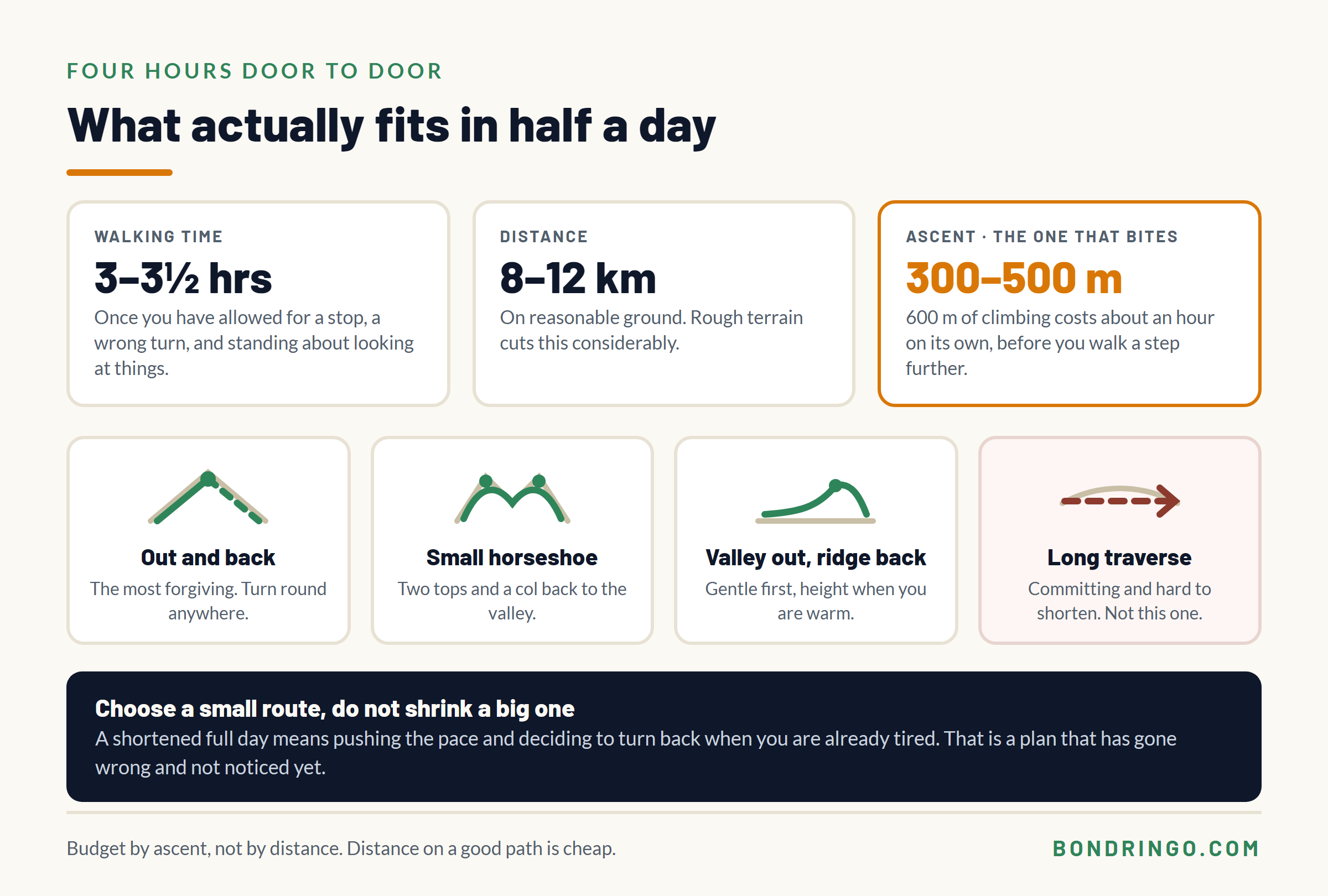
A shortened big walk and a half-day walk are different things. One is a plan. The other is a plan that has already gone wrong and hasn’t noticed yet.
Choose the smaller route from the start and you get an unhurried afternoon instead of a slightly anxious one.
What Actually Fits
Rough numbers, and treat them as a starting point rather than gospel.
If you’re out for four hours door to door, you’ve realistically got about three to three and a half hours of walking once you’ve allowed for a stop, a wrong turn and standing about taking photographs.
Using Naismith’s Rule as the base, that’s in the region of eight to twelve kilometres with three to five hundred metres of ascent, depending on the ground and how fast you walk.
In practical terms that’s plenty:
- One decent summit and back down, in most UK hill areas.
- A short horseshoe taking in two tops.
- A valley walk with one climb out and a high-level return.
- A section of a long-distance route, walked as an out-and-back or between two bus stops.
The two things that eat a half day faster than anything else are ascent and rough ground. Distance on a good path is cheap. Six hundred metres of climbing is an extra hour on its own, before you’ve walked a step further.
One habit worth borrowing from walk leaders: time a couple of easy legs at the very start. If the first kilometre took eighteen minutes rather than twelve, you now know that today’s plan needs trimming, and you know it while you’re still near the car rather than three hours in.
Never Feel Lost Again: The Free UK Navigation & Safety Pack
Stop relying solely on a fragile phone battery. Download the exact tools a professional outdoor instructor uses to stay safe in the British hills.

Enter your email below to get instant access to:
- NEW: The Hike Planning & Safety Checklist: A comprehensive pre-walk checklist to ensure you never leave a critical item behind or rely purely on a smartphone.
- The Emergency Protocol Guide: A highly structured, zero panic system detailing exactly what to do if lost on Dartmoor/Scottish hills, including when and how to call Mountain Rescue.
- The OS Map & Navigation Cheat Sheet: A quick reference guide to decoding complex map symbols and plotting grid references when your mind goes blank.
- The Route Card Template: The exact, logic-driven framework I use to plan foolproof expeditions and identify safe escape routes before leaving the house.
- The Timing Crib Card: Never misjudge daylight again. Master the mathematics of measuring pacing distance and timings for steep ground.
How to Find One on a Map
Ten minutes, and it’s a genuinely enjoyable job.
Start from the car park or the station, not the summit. Look at where you can actually begin, then see what’s within a couple of hours of it. This is the opposite of how most people plan and it produces far better short walks.
Count the contour lines, not the kilometres. Two flat kilometres and two kilometres climbing three hundred metres are completely different afternoons. The ascent is what you’re budgeting.
Look for a route with a natural turning point. A summit, a col, a lake, a ruin. Something that makes the halfway feel like an arrival rather than an arbitrary stop.
Check there’s a way to shorten it further. Even a short walk benefits from having somewhere to bail out, because weather doesn’t care how long you planned to be out.
Consider going by public transport. Short walks suit trains and buses beautifully, because you can start at one station and finish at another without a car to return to. We’ve written about walking the UK hills without a car if that’s an option where you are.
The Shapes That Work Best
Not all routes shrink well.
Out-and-back to a summit. The most forgiving shape there is. You know the ground on the return, you can turn round at any point, and the timing is easy to judge because the second half mirrors the first.
A small horseshoe. Two tops and a col, dropping back into the valley you started in. More interesting than an out-and-back and usually just as manageable.
Valley out, ridge back. Gentle on the way out, and you get the height on the return when you’ve warmed up.
Station to station. Genuinely underrated. No car to return to, so the walk can go somewhere rather than in a circle.
What doesn’t work is a long linear traverse or a big plateau crossing. Both are committing, both are hard to shorten, and neither is what you want when the clock is the constraint.
What Not to Skimp On
Short walks are where people get casual, and the hill does not know how long you planned to be out.
Take the headtorch. Especially in autumn. An afternoon walk that runs an hour over is a night walk.
Take a warm layer and something to eat. A twisted ankle two kilometres out is a long, cold wait whether the route was four hours or ten.
Tell someone anyway. It takes thirty seconds and it’s the same thirty seconds as for a big day.
Take the map. Short does not mean simple. Some of the most confusing ground in Britain is close to roads.
Our kit list for the hill is the full version, and none of it changes because the walk is shorter.
Making Half Days Count
A few ways to get more out of them than just the exercise.
Use them as practice ground. Half days near home are the ideal place to work on navigation, because being wrong costs you almost nothing. That’s the whole argument in our guide to practising navigation without getting lost.
Use them to recce bigger routes. Walk the first third of a long day you fancy. You’ll know the approach, the parking and the ground, and the big day gets considerably easier.
Use them for the weather window. A four-hour gap in a bad forecast is unusable for a full day and perfect for a short one. The Met Office mountain forecast covers ten UK upland areas and is updated twice a day, which is detailed enough to spot those gaps rather than writing off the whole weekend.
Use them in winter. This is when half days stop being a compromise and start being simply the correct size of walk. In midwinter it can be going dark by four o’clock, which means a route that fits comfortably in a July evening is a night walk in December. Plan the shorter thing and enjoy it, rather than planning the longer thing and racing the light.
Use them to build up safely. If you’re working towards bigger days, short local walks are how you get there, but don’t add distance and ascent too fast. A useful rule of thumb is to increase your weekly walking volume by no more than about ten per cent. Tendons and knees adapt considerably more slowly than enthusiasm does.
The Short Version
Half a day is roughly eight to twelve kilometres and three to five hundred metres of ascent. That’s a summit, a small horseshoe, or a station-to-station line.
Pick a route that size from the start rather than trimming a bigger one, budget by ascent rather than distance, and take exactly the same kit you would for a full day.
Then go, because the afternoon walks are the ones that actually happen.
Frequently Asked Questions
How far can you walk in half a day?
Realistically about eight to twelve kilometres with three to five hundred metres of ascent, if you’re out for around four hours door to door. That allows for stops and for not moving at a forced pace throughout. The variable that matters most is ascent rather than distance: six hundred metres of climbing adds roughly an hour on its own, so a shorter, steeper route can take longer than a flatter one twice its length.
Is a half-day walk long enough to be worth it?
Yes, and in practice they are the walks most people actually do. You get the same hills, weather and navigation as a full day without needing a whole free Saturday and a perfect forecast. Over a year, frequent short walks build far more confidence and competence than occasionally waiting for the ideal big one.
How do I plan a shorter version of a longer walk?
Generally you shouldn’t. Choose a smaller route instead. Shortening a full-day walk usually means pushing the pace and making the turn-back decision when you’re already tired, which is how afternoons end in the dark. If you do want a piece of a bigger route, walk it as a deliberate out-and-back to a specific point and treat that point as the destination.
What kit do I need for a half-day hill walk?
The same as for a full day. A headtorch, a warm layer, waterproofs, food, water, a map and compass, and a charged phone. The hill does not know how long you intended to be out, and a short walk that runs over becomes a walk in the dark just as easily as a long one.
What is the best route shape for a short walk?
An out-and-back to a summit is the most forgiving, because you know the ground on the return and can turn round at any point. A small horseshoe over two tops is more interesting and usually just as manageable. Station-to-station walks work particularly well when there is no car to return to. Long linear traverses and plateau crossings are the ones to avoid.
Are short walks good for practising navigation?
They are the best ground there is. You’re close to the road, you can’t get seriously lost, and a mistake costs you very little, which is exactly the condition under which people are willing to put the phone away and try. Practising on familiar half-day routes is far more effective than saving navigation for big committing days.
Get More Out of the Afternoons You Do Have
If short walks are what realistically fits your life, the thing that makes them count is being able to plan them quickly and navigate them confidently.
The free Digital Safety Net course is sixteen lessons on getting your planning and your phone genuinely reliable, so an afternoon walk takes ten minutes to plan rather than an evening. It costs nothing.
So, what’s within an hour of your front door that you haven’t walked yet? Ask any questions in the comments below.


